
By September of last year, President Barack Obama had had enough of ISIS. The terror group had beheaded two American journalists and was seizing strategic cities and territory in Syria and Iraq.
"We will hunt down terrorists who threaten our country, wherever they are," Obama vowed, expanding his bombing campaign from Iraq into Syria as well.
And the United States lined up allies in the region, producing a joint declaration with 10 Middle Eastern countries that vowed a "comprehensive fight against" ISIS. The key prongs of that strategy were stemming the flow of foreign fighters to ISIS, squeezing its funding "and, as appropriate, joining in the many aspects of a coordinated military campaign."
But since then, about 80 percent of coalition bombing has been by the United States, with some support from allies in Europe, plus Canada and Australia. In fact, the United States is dropping bombs faster than it can replenish them.
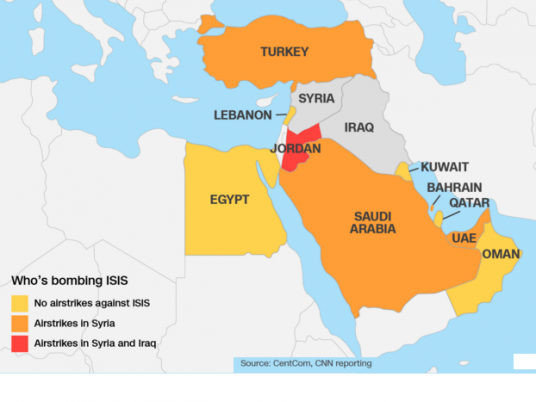
Turkey, which is not Arab and was not part of the September 2014 announcement, is also carrying out some strikes against ISIS in Syria.
The 10 Arab allies against ISIS have refused to say how many airstrikes they have carried out against ISIS, but Pentagon statements reveal that half the Arab countries in the coalition have carried out no bombing in Iraq and Syria at all.
Bahrain and Jordan haven't dropped any bombs in months, according to a US official speaking on background about the actions of allies, and Saudi Arabia and the United Arab Emirates bomb about once a month. (The final country in the coalition is Iraq, which is a separate case because it's fighting ISIS within its own borders.)
So could Middle Eastern countries be doing more to fight ISIS? There are both political and strategic factors holding them back, including regional rivalries and domestic pressures.
But critics say they could be doing more than they are. Here's a roundup of the military capabilities of the 10 countries that joined the United States in the Jeddah Declaration.
Bahrain
Army: 8,500 troops
Navy: 1,000
Air force: 1,500
Fixed-wing combat aircraft: 29
Military action: Some bombing of ISIS in Syria, last carried out in early autumn. The US Navy's Fifth Fleet is based in Bahrain.
Egypt
Army: 340,000 troops
Navy: 18,500
Air force: 100,000
Fixed-wing combat aircraft: 405
Military action: No bombing in Iraq or Syria, but Egypt has bombed the ISIS affiliate in Libya. The Egyptian army is fighting the ISIS affiliate in the Sinai Desert.
Iraq
Army: 274,600 troops
Navy: 3,700
Air force: 5,100
Fixed-wing combat aircraft: Unknown
Military action: Fighting ISIS in Iraq
Jordan
Army: 88,000 troops
Navy: 500
Air force: 15,000
Fixed-wing combat aircraft: 68
Military action: The only Arab country to have bombed ISIS in both Syria and Iraq, but it last carried out airstrikes in August.
Kuwait
Army: 11,000 troops
Navy: 2,700
Air force: 2,500
Fixed-wing combat aircraft: 39
Military action: No bombing. Kuwait has agreed to serve as a base for coalition forces, aircraft and equipment waiting to be sent to Iraq.
Lebanon
Army: 53,900 troops
Navy: 1,100
Air force: 1,000
Fixed-wing combat aircraft: 4
Military action: No bombing. The army is fighting ISIS within Lebanon's borders.
Oman
Army: 31,400 troops
Navy: 4,200
Air force: 3,500
Fixed-wing combat aircraft: 32
Military action: No bombing
Qatar
Army: 8,500 troops
Navy: 1,800
Air force: 2,100
Fixed-wing combat aircraft: 18
Military action: No bombing. Funding opposition fighters in Syria. US Central Command Forward Headquarters is at Al Udeid Air Base in Doha.
Saudi Arabia
Army: 75,000 troops
Navy: 15,500
Air force: 34,000
Fixed-wing combat aircraft: 259
Military action: Bombs ISIS in Syria about once a month. Funding opposition fighters in Syria.
United Arab Emirates
Army: 59,000 troops
Navy: 2,400
Air force: 4,000
Fixed-wing combat aircraft: 148
Military action: Bombs ISIS in Syria about once a month.
