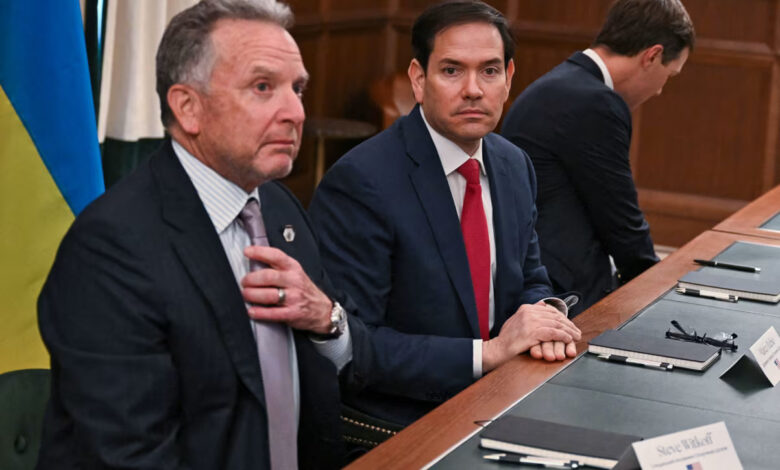
Inside the Witkoff Group’s exclusive Shell Bay private members club in South Florida, the delegations from Washington and Kyiv faced each other for “tough but very constructive” negotiations over lashings of Ukrainian Borsch, a beetroot and cabbage soup which one attendee told me was “very rich with meat.”
But its serving, along with Holubtsi, traditional meat and cabbage rolls, was seen as a welcome nod to Ukrainian culture – a deft diplomatic gesture as the US tries to coax Ukraine towards compromising on a peace deal with Russia.
A source with direct knowledge of the Florida talks – involving US Secretary of State Marco Rubio, Special Envoy Steve Witkoff and President Donald Trump’s son-in-law Jared Kushner – tells CNN the intensive negotiations were a “step forward” and “built on progress in Geneva,” where a first round of discussions on US proposals to end the Russian war in Ukraine were held last week.
“It would be very premature to say we finalized everything here as a lot of things have still to be done,” the source told CNN.
“But the meeting was very focused and the most problematic aspects of the peace proposals were discussed in detail,” the source added, hinting that tentative progress in some areas could be made.
One of the most “problematic aspects” of the original 28-point US peace proposal was the stipulation for Ukraine to formally renounce its aspiration, enshrined in its constitution, to join NATO – a key Russian demand to end the war and something Ukrainian officials continue to reject.
However, the CNN source now says negotiators have discussed a possible scenario in which Ukraine would effectively be barred from joining the US-led Western military alliance via arrangements that would have to be negotiated directly between NATO member states and Moscow.
“Ukraine will not be pushed to officially, in the legal sense, reject this aspiration,” the source told CNN.
“But if the United States has something to agree upon with Russia bilaterally, or if Russia wants to receive some assurances from NATO multilaterally, then this is not engaging Ukraine in the decision-making process,” the source added.
A final decision on what would be a highly sensitive compromise – likely to be unpopular among NATO states – has not yet been taken and would ultimately be made by the Ukrainian president, the source stressed to CNN.
But it suggests that, as US-Ukraine negotiations proceed, and as Witkoff travels to Moscow for talks at the Kremlin, creative solutions to tiptoe around Kyiv’s red lines are being explored.
Another one of those problematic areas is the Kremlin demand, which also found its way into the 28-point US peace proposal, for Ukraine to surrender territory in the Donbas region of Eastern Ukraine that has been annexed, but not yet conquered, by Russia.
The US plan suggested the region, which includes a “fortress belt” of heavily defended towns and cities seen as crucial to Ukrainian security, become a Russian demilitarized zone, which Moscow would administer but not deploy military forces into.
The source, who has direct knowledge of the negotiations, tells CNN that discussions are also progressing on this issue – one of the most controversial in the negotiations.
“The idea to give up the control to Russians, where it would significantly weaken Ukraine’s defense and make further potential aggression more likely to happen and significantly decrease Ukraine’s capability, this is out of the scope,” the source told CNN.
“But that doesn’t mean that there are no potential ways of preserving the constitutional provisions and keeping Ukraine’s security,” the source added.
However, the source refused to discuss what specific options are under discussion, saying the issue is “too sensitive.”
“I really believe that if it becomes public, we may ruin the potential solution,” the source told CNN.
There may be another spoiler unmasked in the days ahead too: a Kremlin that has so far refused to curb any of its maximalist demands to subjugate Ukraine before ending the war.
Amid hints of Ukrainian compromises being forged by US negotiators, the next and bigger challenge in America’s shuttle diplomacy may be getting Russia to accept them.