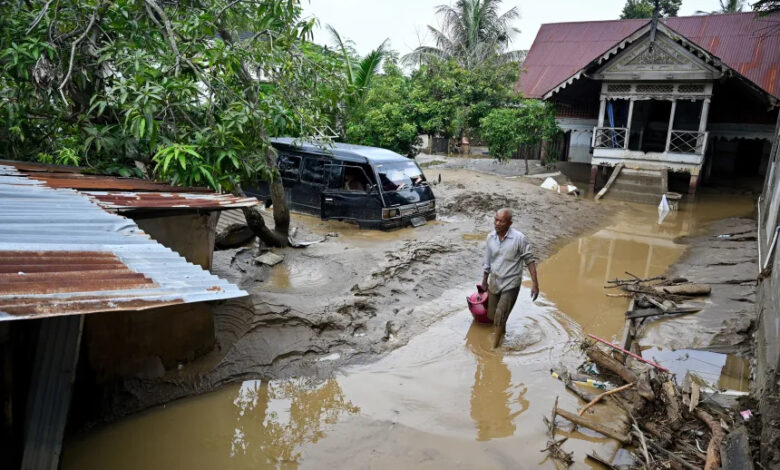
Heavy rainfall has unleashed widespread flooding and landslides across Asia, killing more than 1,000 people and creating treacherous search and rescue operations for hundreds more still missing.
Millions of people are dealing with intense flooding after cyclone-fueled downpours battered parts of Indonesia, Thailand and Malaysia.
Sri Lanka was struck by a separate storm, leaving some areas submerged and creating the most difficult rescue operation the country’s ever seen, according to President Anura Kumara Dissanayake.
“This is the first time the entire country has been struck by such a disaster,” he said in an address to the nation, Reuters reported, suggesting the breadth of devastation has surpassed that caused by the Asian tsunami in 2004.
Across Asia, the severe weather has so far claimed the lives of at least 502 people in Indonesia, 355 in Sri Lanka, 176 in Thailand and two in Malaysia, according to officials – taking the total to 1,035.
In Indonesia
Indonesian rescue teams are struggling to reach the hardest-hit areas of Sumatra, where Cyclone Senyar caused catastrophic landslides and flooding.
President Prabowo Subianto visited evacuees in the north of the island on Monday, noting challenges with fuel supply and roads, according to Antara, Indonesia’s government-run news agency.
At least 502 people have died, government data on Sunday showed, and over 500 more are still missing. Military and police have been deployed to help victims, local media reported.
Video footage shows helicopters delivering supplies to Sumatra, renowned for its lush rainforests, active volcanoes and a critically endangered orangutan population.
“During the flood, everything was gone,” a resident of Bireuen, in Sumatra’s northernmost province Aceh, told Reuters.
“I wanted to save my clothes, but my house came down.”
Maulidin, a 41-year-old resident of North Aceh, fled her home with her family when she woke to the sound of flooding.
“My house is already destroyed, all my belongings are ruined, and mud is inside,” she told AFP.
Rescuers have been trying to reach residents stranded by the floodwaters since Tuesday when monsoon rains caused rivers to overflow.
Some people have turned to stealing food and water in order to survive, according to local authorities.
“The looting happened before logistical aid arrived,” police spokesperson Ferry Walintukan said, according to AP. “(Residents) didn’t know that aid would come and were worried they would starve.”
In Thailand
Across the strait, at least 176 people have died due to extreme weather in southern Thailand, the country’s disaster agency told CNN.

Almost 2.8 million people have been affected, with authorities airlifting patients and flying critical supplies, including oxygen tanks, to submerged communities, Reuters reported.
Amphorn Kaeophengkro and her family of eight rushed to the second floor of their home when floodwaters swept in last Saturday, spending 48 hours perched atop a table, washing machine and on a window frame.
“We weren’t thinking about anything else except surviving,” the 44-year-old told Reuters by candlelight, as her family began to clean their dwelling after the water had receded.

“Sometimes we sat at the edge of the window and had to lift our legs to avoid keeping them too deep in the water.”
Hat Yai city was Thailand’s hardest-hit region, recording the type of heavy rain the occurs once-in-300-years, bringing floodwaters more than eight feet high on Tuesday and cutting off access to a maternity ward holding 30 newborn babies, staff and officials said.
The city is part of Thailand’s Songkhla region, where the government declared an emergency on Tuesday due to severe flooding, an official said on X.
Ten tourists, from Australia, Britain, China, Malaysia, Singapore and South Africa, were rescued in Songkhla province on Friday, the Ministry of Tourism told CNN.
“The situation has improved significantly. Water levels have almost completely receded, with only some areas remaining flooded,” a spokesperson said.
In Sri Lanka
More than 1.1 million people felt the wrath of Cyclone Ditwah, which triggered mud slides and flooding on Friday, Reuters said.
At least 355 people were killed and another 366 remain missing, according to Sri Lanka’s Disaster Management Center.


Over 25,000 homes have been destroyed and 147,000 people have been forced into state-run temporary shelters, AP reported.
Some families have been stranded for four days, with no power or phone reception to call for help, Moses Akash De Silva, director of the Voice for the Voiceless Foundation, told CNN Monday.
The charity has so far provided 4,000 meals to families who have lost their homes near Colombo. De Silva and volunteers shopped for ingredients on boats in the floodwaters, cooking meals of fish, meat or egg with curry and rice.
When the water subsides and families return home, the foundation will provide dry rations, like rice and flour, and household items like gas cookers and mattresses to support their rebuilding efforts, De Silva said.
“There is a huge demand and many people have to start again from zero,” he told CNN. “The last time we had severe floods was in 2016 and this is 10 times worse.”
“It is sunny today but there is still a big risk of landslides.”
Ruvinda Bernard, a travel agent who volunteers at the charity, added: “Yesterday, we got a call from three families still stuck on a roof with no way of getting down.”
“The Colombo rowing club said they had one so we called the police’s special taskforce to arrange a lorry to transport it to the water to rescue them.”
Meanwhile, Mallika Kumari was among more than 78,000 people moved to relief centers, mostly set up in schools, after her home was quickly submerged, according to Reuters.
“I first heard about the flood warning on TV but we never expected the river to overflow so quickly. We just rushed out of the house without anything,” Kumari told reporters.
“We haven’t even had breakfast. Two of my sons have caught the flu. I have to get them medication. I’ve brought a few garbage bags to collect their clothes.”
In the rush, Kumari left behind her cat, which was later picked up by a navy boat and brought to dry land.
Selvi, a 46-year-old resident of Colombo’s Wennawatte suburb, fled her home with four bags of clothes and other possessions. “My house is completely flooded. I don’t know where to go, but I hope there is some safe shelter where I can take my family,” she told AFP.
At the Dalugala Thakiya Mosque, volunteers prepared rice parcels with chicken and dhal curry for flood victims.
“We are getting more requests for food because people who work daily jobs cannot find work and are running low on savings,” meal organizer Risham Ahmed told Reuters.
“They are worried about how to piece their lives back together.”
In Malaysia
In Malaysia, two people were confirmed dead after Senyar, then a tropical storm, made landfall shortly after midnight on Friday, Reuters said.

Around 34,000 people were evacuated ahead of the storm, but Gon Qasim and her husband were less fortunate, stranded in a field in northern Perlis state last weekend when rising floodwaters cut off their escape.
The elderly couple were eventually rescued by one of their children and brought to an evacuation center in the state capital of Kangar, where hundreds of families sheltered in tents provided by the national disaster management agency, Reuters reported.
“I was inside, and I couldn’t go out. When I was out, there was nowhere to stay but the field,” the 73-year-old Gon said told its reporters, recalling her ordeal in an interview on Wednesday.
“The water was like the ocean. That’s what it looked like.”
Climate change
Southeast Asia, which includes Indonesia, Thailand and Malaysia, is one of the areas most vulnerable to climate change, scientists have warned.

Current extremes of weather in the region could stem from the interaction of two active systems, Typhoon Koto in the Philippines and the unusual formation of Cyclone Senyar in the Malacca Strait, meteorologists told Reuters.
Elsewhere in Southeast Asia this month, deadly floods devastated parts of Vietnam, where flooding and landslides killed dozens of people.
Also in the region this month, the Philippines endured two deadly typhoons – Kalmaegi and Fung-wong – in a week, which killed hundreds of people and forced more than 1.4 million to evacuate.
This summer, the region also saw temperatures reach unprecedented levels, with little respite from merciless heat and humidity, climatologist Maximiliano Herrera told CNN.