Japan said Monday that Chinese military aircraft locked radar on its fighter jets even though there was a safe distance between them, denying Beijing’s accusation of interference and renewing its protest over the incident.
“The Self Defense Force (fighter jets) were maintaining safe distance during their mission,” Chief Cabinet Secretary Minoru Kihara told reporters. “China’s claim that SDF aircraft severely obstructed their safe flight is untrue.”
Japan and Australia urged calm on Sunday after Chinese military aircraft locked radar on the Japanese fighter jets. The incident occurred a month after the Japanese leader’s remarks on Taiwan stirred tensions between Tokyo and Beijing.
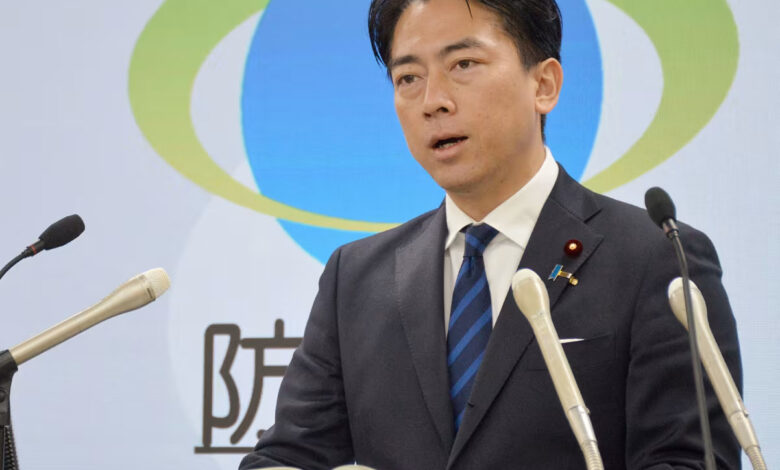
Defense Minister Shinjiro Koizumi said Japan formally protested the incident, calling it “an extremely regrettable” act and “a dangerous” one that “exceeded the scope necessary for safe aircraft operations.”
“We have lodged a strong protest with the Chinese side and demanded strict preventive measures,” Koizumi said.
Japan’s Defense Ministry said China’s military aircraft J-15 took off from the Chinese carrier Liaoning near the southern island of Okinawa on Saturday and “intermittently” latched its radar on Japanese F-15 fighter jets on two occasions Saturday, for about three minutes in the late afternoon and for about 30 minutes in the evening. It was not made clear whether the radar lock incident involved the same Chinese J-15 both times.
Japanese fighter jets had been scrambled to pursue Chinese ones that were conducting aircraft takeoff and landing exercises in the Pacific. They were pursuing the Chinese aircraft at a safe distance and did not take actions that could be interpreted as provocation, Kyodo News agency said, quoting defense officials, when the radar lock happened. There was no breach of Japanese airspace, and no injury or damage was reported from the incident.
Senior Colonel Wang Xuemeng, spokesperson for the Chinese navy, defended China’s flight training near the island of Miyako Saturday, saying Beijing announced the exercises beforehand and accused Japanese aircraft of “harassment.”
“We solemnly asked the Japanese side to immediately stop slandering and smearing, and strictly restrain its frontline actions. The Chinese Navy will take necessary measures in accordance with the law to resolutely safeguard its own security and legitimate rights and interests,” Wang said in a statement posted Sunday on the Chinese Ministry of Defense website.
Kihara on Monday stressed the importance of maintaining communications between the two sides but declined to say whether a hotline launched in 2018 between them was used during the lock-on incident.
At an emergency meeting Monday, senior officials from the ruling Liberal Democratic Party expressed concern that the radar incident may signal an elevated security risk from China.
Relations between Japan and China have worsened after Japan’s Prime Minister Sanae Takaichi said in early November its military could get involved if China were to take action against Taiwan, the self-governing island that Beijing claims as its own.
Takaichi later Sunday called the radar lock-in “extremely disappointing.”
“We will act calmly and resolutely,” she said, vowing to do the utmost in carrying out surveillance operations around Japanese waters and airspace, while closely watching Chinese military activity around Japan.
Japan and Australia, whose defense ministers held their scheduled talks in Tokyo on Sunday, expressed worry over the development.
“We are deeply concerned by the actions of China in the last 24 hours,” Australian Defense Minister Richard Marles told a joint news conference Sunday after holding talks with Koizumi. “We expect those interactions to be safe and professional.”
Australia does “not want to see any change to the status quo across the Taiwan Straits,” Marles said, adding that China is his country’s largest trade partner and he wants to have productive relations with Beijing.
“We continue to advocate to China about these issues again, in a very calm, sensible and moderate way,” he said.
Japan and Australia, during Sunday talks, agreed to bolster military ties to lead the region’s multilateral defense cooperation. The two ministers agreed to form a comprehensive “framework for strategic defense coordination” and discuss further details.
Tokyo has been accelerating its military buildup while expanding its defense ties beyond its only treaty ally, the United States. It now considers Australia to be a semi-ally.
Marles also visited a Mitsubishi Heavy Industries shipyard in Nagasaki on Saturday to observe production of the upgraded Mogami-class frigate that his country chose in September as a replacement for its aging fleet.
Saturday’s radar lock is believed to be the first involving Japanese and Chinese military aircraft. In 2013, a Chinese warship targeted a radar on a Japanese destroyer, Kyodo said.
Fighter jets use radars for search operations or fire control ahead of a missile launch.
Elsewhere in the Pacific, the Philippine coast guard said China fired three flares toward a fisheries bureau plane on patrol in the South China Sea on Saturday. Chinese forces fire flares to warn planes to move away from what they consider their airspace over the disputed waters.