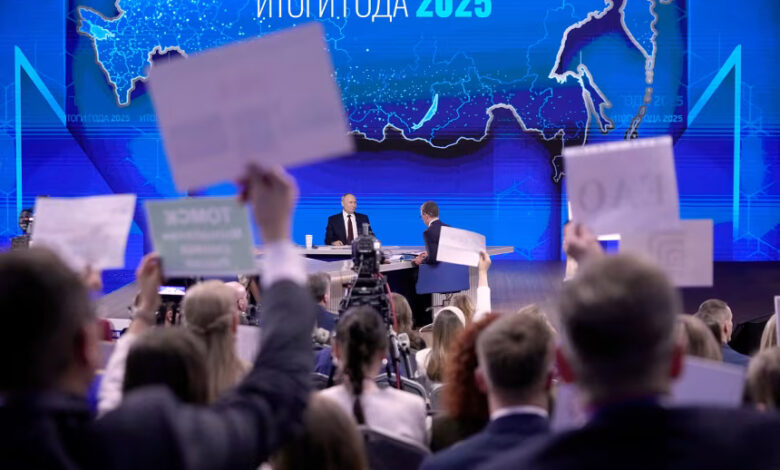
Russian President Vladimir Putin’s annual marathon press conference is perhaps best summarized as a mashup of a municipal board meeting and geopolitical talkfest. The Kremlin leader makes sweeping pronouncements about the current global order, interspersed with small-bore questions from local journalists about the quality of roads in the Komi Republic.
But this year’s direct-line event comes on the heels of Europe throwing a $105 billion lifeline to Ukraine in the form of an interest-free loan to keep Kyiv in the fight against Moscow.
While Brussels stopped short of enacting a controversial proposal to divert billions in frozen Russian assets held in Europe to Ukraine, the loan quite literally gives the Ukrainians time – and ammunition – as the war launched by Putin in February 2022 approaches the four-year mark.
Perhaps with that aid package in mind, Putin was pretty unsparing in his remarks on the war. He began by listing Moscow’s incremental gains on the battlefield, saying Russia was “advancing across the whole of the front line,” and reeled off a list of towns and villages that Russian forces now claim full or partial control over.

Putin also deflected blame for the extraordinary loss of life, claiming against all evidence that the Kremlin “did not start this war.” But the Russian president did signal a sort of openness to reaching a negotiated end to the conflict, saying Russia was “ready and willing to end this conflict peacefully, based on the principles I outlined last June at the Russian Ministry of Foreign Affairs, and by addressing the root causes that led to this crisis.”
But that phrase – “the root causes” – is an important caveat. It’s Putin’s shorthand for the same demands that he made to Ukraine and the West on the eve of the full-scale invasion: Kyiv’s complete withdrawal from the Donbas region, no more NATO expansion and some form of regime change in Ukraine.
Back in 2022, Putin used a longstanding grievance about NATO expansion after the end of the Cold War to make his case for going to war against Ukraine. He echoed the same sentiments on Friday, saying in response to a question from BBC reporter Steve Rosenberg that there wouldn’t be more “special military operations” like the full-scale invasion of Ukraine “if you treat us with respect.”
That language of resentment – “they simply screwed us over,” to use Putin’s words – glosses over the fact that the 2022 invasion of Ukraine actually prompted the expansion of NATO in the Nordic region.
But it also suggests that Putin’s red lines have not really shifted as the Trump administration presses ahead with an unconventional diplomatic effort to bring the warring parties to the negotiating table.
US President Donald Trump’s special envoy Steve Witkoff is expected to meet with Kirill Dmitriev, the head of Russia’s sovereign wealth fund and a key Putin aide, in Miami on Friday to discuss the latest iteration of a proposal to end the war in Ukraine.
On Friday, Putin complimented Trump for his efforts to end the war, saying the American president was “making serious efforts to end the conflict.”
It is as yet unclear how sincere Putin is about ending the same war.
CNN’s Anna Chernova, Christian Edwards, Katharina Krebs and Alejandra Jaramillo contributed reporting.