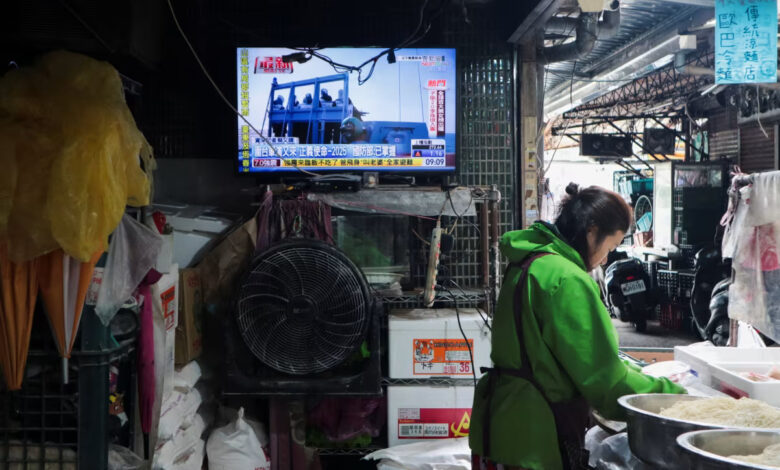
China’s military announced Monday it was mobilizing army, navy, air and rocket units around Taiwan for “major military drills” aimed at sending a “serious warning” against any push for Taiwanese independence and “external” forces interfering with the island.
The exercises – dubbed “Justice Mission-2025” – would test combat readiness and “blockade and control of key ports and critical areas” from Monday, China’s Eastern Theater Command said. Live-fire activities would take place in five maritime and airspace zones encircling the island on Tuesday, according to information released by the command.
Taiwan’s government condemned the drills, accusing China of “military intimidation,” while its defense ministry said it was “fully on guard” and would “take concrete action to defend the values of democracy and freedom.”
Beijing has in recent years ramped up its military intimidation of the island – long seen as a potential flashpoint in a fractious region – including by simulating blockades. Analysts say that based on the military announcements the latest drills may be more explicitly aimed at practicing how to deny foreign military access to the area.
The drills announced Monday would focus on training precision strikes, combat readiness, and “systemic” blockade and control and “deterrence outside the island chain,” according to Shi Yi, spokesperson for the Eastern Theater Command, in an apparent reference to a strategic line considered key in any potential regional military conflict.
China Coast Guard also said it was launching patrols in waters around Taiwan.
The military flex also appears to follow a playbook Beijing has used in the past: launching major drills at sensitive moments to express its displeasure.
Washington and Taipei earlier this month announced what could become one of the US’ biggest-ever military sales to the island, and Taiwan’s president is pushing for the approval of a historic special defense budget – developments that have irked Beijing.
Meanwhile, China and Japan have been locked in a weeks-long diplomatic spat over comments the Japanese prime minister made about Taiwan.
‘Collusive actions’
China’s ruling Communist Party claims the self-governing democracy of Taiwan as its own territory, despite never having controlled it, and has vowed to take control of the island, by force if necessary.
“This exercise serves as a serious warning to ‘Taiwan independence’ separatist forces and external interfering forces,” Shi, the command spokesperson said, using what appeared to be a veiled reference to the US and its allies. “(It) is a legitimate and necessary action to safeguard national sovereignty and maintain national unity.”
Other voices cited in Chinese state media were more explicit. In an interview published on a social CCTV, military analyst Fu Nan pointed to the US and Taiwan arms deal when asked why the drills were taking place at this time, calling it an “escalation” of “collusive actions.”
In a statement, Taiwan’s presidential spokesperson Karen Kuo said the drills “blatantly undermine the security and stability status quo of the Taiwan Strait and the Indo-Pacific region” and “openly challenges international laws and order.”
Taiwan’s President Lai Ching-te champions Taiwan’s sovereignty but has not formally called for independence. He has pledged to maintain the status quo.

US arms deal
The landmark $11.1 billion arms deal between US and Taiwan includes HIMARS rocket systems, anti-tank and anti-armor missiles, loitering drones, howitzers and military software.
Washington recognizes the People’s Republic of China as the sole legitimate government of China, but maintains close unofficial ties with Taipei, which have strengthened in recent years. It is bound by law to provide the island with the means to defend itself and supplies it with defensive weaponry.
Beijing slammed the recent arms deal announced between the two, with its Foreign Ministry earlier this month saying the move “infringes on China’s sovereignty, security and territorial integrity” and “undermines peace and stability in the Taiwan Strait.”
When asked whether the drills were in response to the US-Taiwan arms deal, a spokesperson for China’s Foreign Ministry on Monday referenced Taiwan’s governing party and said the exercises were “a severe punishment for the separatist forces seeking independence through force.”
“Their attempt to seek independence through the US, even at the cost of turning Taiwan into a powder keg, fully exposes their vicious nature as peace disruptors, troublemakers, and war instigators. External forces using Taiwan to constrain China and arm Taiwan will only embolden the arrogance of pro-independence forces and push the Taiwan Strait to a dangerous state of war,” the spokesperson, Lin Jian, added.
Taiwan is seen by Beijing as the principle “red line” in US-China relations, with Chinese officials long condemning the unofficial relationship between Taipei and Washington.
Taiwan has been ramping up military purchases in recent years as it comes under increasing pressure from Beijing, with Chinese aircraft and ships present almost daily around Taiwan as well as regular large-scale exercises in and over the surrounding waters.
Parts of latest deal, however, are expected to be paid for as part of an historic $40 billion special defense budget Taiwan’s President Lai Ching-te proposed in late November. It has struggled to gain approval in Taiwan’s opposition-controlled legislature, which is locked in an acrimonious gridlock.
Regional frictions around Taiwan have also been heightened in recent weeks as Beijing has unleashed a diplomatic and economic pressure campaign on US ally Japan after its Prime Minister Sanae Takaichi suggested her country could respond militarily if China were to move to take control of Taiwan by force.
The announcement of the latest military drills has been accompanied by the usual release of nationalistic propaganda geared toward China’s domestic audience, including a poster showing fiery arrows reigning down on the island captioned “Arrow of Justice, Control and Denial.”
Another AI-generated video titled “Joint Operations to Thwart ‘Taiwan Independence’ Attempts” showed images of menacing robot dogs and armed humanoid robots as well as planes and ships apparently bearing down on Taiwan.
‘Deny intervention’
China’s drills around Taiwan have grown in complexity and scope in recent years, with analysts pointing to the increased emphasis on simulating blockades and suggesting that Beijing may be looking to blur the line between drills and activities preparing for an attack.
The latest drills appear set to follow a similar encirclement strategy. A notice released by China’s Maritime Safety Administration under its Transport Ministry listed seven zones for military exercise, including live-fire drills, taking place Tuesday. Five of those zones are the same as those announced by the People’s Liberation Army.
While those zones may cover both military and law enforcement exercises, taken together they appear to amount to a “de facto” blockade inside the Taiwan Strait, according to K. Tristan Tang, an associate fellow at the Secure Taiwan Associate Corporation, a Taipei-based think tank.
That would cover “almost every sea route” between Taiwan and its strategically important, outlying islands Kinmen and Matsu close to the mainland, Tang told CNN.
While analysts were awaiting further details of the operations, several observers within Taiwan pointed to what appeared to be signs of a heightened focus on denying external access to waters around Taiwan in the language used by the PLA as it announced the drills.
“The PLA aims to deny intervention by foreign military forces in conflicts around Taiwan and keep them out,” Chieh Chung, an associate research fellow at Taiwan’s Institute for National Defense and Security Research (INDSR), told CNN. “Beijing is very explicit about that objective in this drill”.
A propaganda poster released by the PLA on Monday showing a huge shield emblazoned with China’s Great Wall appeared to suggest as much. It was shared on social media platform Weibo with the caption: “All external intervention will perish upon the shield.”
It was not immediately clear how long the sabre-rattling would last. China’s Eastern Command said naval and air forces would run combat readiness patrols from December 29, and the command released a notice announcing the closure of maritime and airspace zones around Taiwan for live-fire drills during daytime hours on December 30.
This story has been updated with additional information. CNN’s Fred He contributed to this report.