“We have a masterplan. … There is no Plan B.”
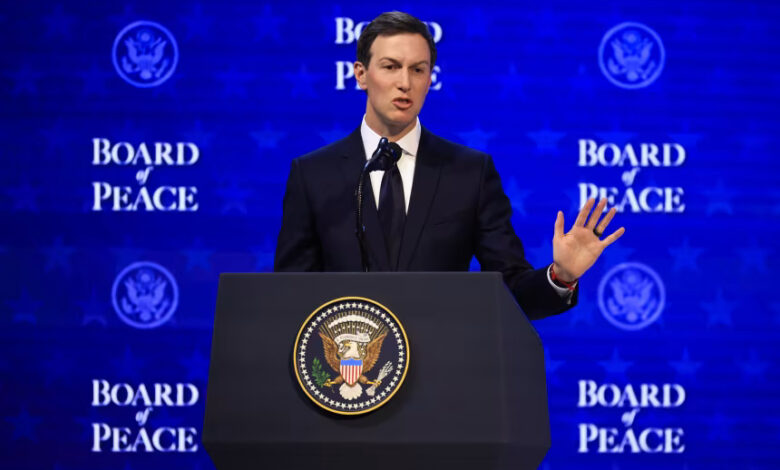
Thus spake Jared Kushner, unveiling his vision for postwar Gaza in front of an audience of the World Economic Forum at Davos.
If it failed, he said, blame would be easy to ascribe.
“If Hamas does not demilitarize, that will be what holds back the people of Gaza from achieving their aspirations,” he said.
The presentation, which felt somewhat rushed, took place immediately after the signing of the charter for US President Donald Trump’s controversial Board of Peace, representing the next stage in the 20-point ceasefire plan agreed between Israel and Hamas in October.
Kushner, the president’s son-in-law, who played a leading role in brokering that agreement, leaned into optimism, albeit with occasional notes of caution and at least one notable omission: the international stabilization force, a key part of Trump’s original ceasefire plan for the Gaza Strip.
Here’s a look at some of the key points:
Coastal tourism, an airport and a port
A map of Gaza was pulled up on a screen to show how the enclave would be developed.
A “coastal tourism” zone would run along the seafront — long enough for up to 180 skyscrapers, many likely earmarked as hotels.

A port was shown at the southwestern end of Gaza, alongside the border with Egypt, and immediately inland from the port, the map showed zoning for an airport.
(A few miles to the south, not marked on the map, lies the site of a previous Gaza airport, destroyed more than 20 years ago in earlier Israeli attacks.)
New cities
Kushner highlighted two urban developments, which he referred to as New Rafah and New Gaza.
At “New Rafah,” more than 100,000 permanent housing units would be built, along with over 200 schools and more than 75 medical facilities, he said. He expressed hope that the construction would be completed within two to three years. Work has already begun to remove the rubble, he said.

“New Gaza” is to be a center of industry, with the aim of achieving 100% full employment, Kushner said. Computer-generated images suggest a metropolis bearing a strong resemblance to Persian Gulf cities like Doha and Dubai, with gleaming waterside accommodations and office locations.

Undoubtedly, the scale of the task is enormous, and the presentation was scant on details about how it would all be realized. Two years of Israeli bombardment, launched in response to Hamas’ attack on Israel on October 7, 2023, has left more than 80% of Gaza’s buildings damaged or destroyed.
Who’s going to pay for it?
Governments will make the first contributions, Kushner said, with initial announcements to come at a conference in Washington in the next couple of weeks.
He also appealed to the private sector to come forward, promising “amazing investment opportunities.”
“I know it’s a little risky to be investing in a place like this, but we need you to come, take faith, invest in the people,” he said.
While senior Palestinian officials have been slow to react to Kushner’s presentation, criticism from elsewhere has highlighted a sense that their powerlessness is being exploited.
“Palestinians face a plan to eliminate their very presence, based on domestication, subjugation, and control,” Ramy Abdu, the Palestinian founder of the Euro-Mediterranean Human Rights Monitor group, posted on X.
What about Israeli withdrawal…
Currently, Israel’s military is present in just over half the territory, including the city of Rafah. The original 20-point plan, which secured the ceasefire and the release of hostages in October, included details about the creation of an international stabilization force (ISF) that would facilitate Israel’s complete withdrawal.
So far, third parties have been reluctant to commit to joining the force, and Israel, for its part, has objected to possible participants such as Turkey.
Kushner made no reference to any international force, while Israel’s withdrawal was reduced to little more than a line on one of the presentation slides: “Gaza-wide demilitarization enables full IDF withdrawal to the security perimeter.”
…and Hamas demilitarization?
The task of overseeing demilitarization, Kushner made clear, will fall to the new technocratic committee — the on-the-ground component of Trump’s Board of Peace structure, made up entirely of Palestinian appointees.
Without it happening, he said, “we cannot rebuild.”

The presentation said that heavy weapons, tunnels, military infrastructure, munitions and production facilities will be destroyed, but it did not dictate how the process will be carried out.
Hamas has tended to say it would hand over weapons only to a Palestinian army in a Palestinian state. More recently, Basem Naim, a senior Hamas official, has spoken of “freezing or storing” its arms in the context of the current ceasefire.
What about the PA and UNRWA?
Quietly, the Palestinian Authority (PA) has expressed concerns that the new technocratic committee represents a threat to its centrality in Palestinian politics.
Kushner’s reference to the committee as “a new government in Gaza” will not have allayed those concerns, though the PA did get one mention on a slide as the eventual sole civilian authority in Gaza, “when it completes its reforms.”
By contrast, the UN Relief and Works Agency (UNRWA) — which provides public services to Palestinian refugees, who number well over half the population of Gaza — looks out of the running.
“We are studying the best practices from all over the world. Who does education the best? Who does health care delivery the best? It’s not a secret IP (intellectual property),” Kushner said, indicating a possible end to the role of UNRWA in Gaza.
Have we heard some of this before from Jared Kushner?
It is not the first time Trump’s son-in-law has unveiled an ambitious vision for Gaza.
In 2019, he hosted a summit in Bahrain under the title, “From Peace to Prosperity,” which also imagined “a bustling commercial and tourist center in Gaza and the West Bank, where international businesses come together and thrive.”
With an almost complete lack of political will across the board, those plans never got off the ground.
This time, the head of Gaza’s new technocratic committee, Ali Shaath, said in a video statement, it is important “to turn this moment into action.”
To that end, he announced the opening next week of the Rafah crossing between Gaza and Egypt, signaling, he said, that the enclave is “no longer closed to the future and to the world.”