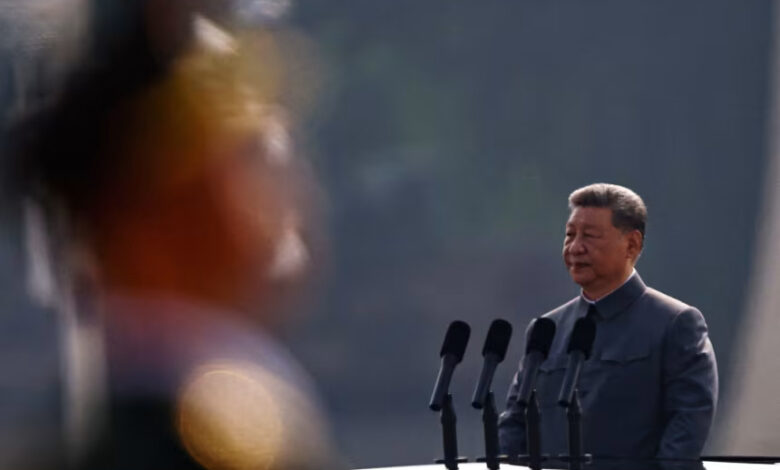
But the purge also makes one thing clear: Xi sees no target as too big to be taken down as he remakes the military according to his vision – and prioritizes loyalty over all else.
The investigations into Zhang Youxia, a battle-tested, seasoned military commander and longtime Xi ally, and Liu Zhenli, who heads People’s Liberation Army (PLA) joint operations, were announced Saturday in a terse 30-second video released by the defense ministry.
A subsequent editorial in the People’s Liberation Army Daily accused Zhang and Liu of “seriously trampling on and undermining the system of ultimate responsibility resting with the Central Military Commission chairman” – jargon that suggests they were a threat to the thing that matters most in Xi’s eyes: his authority.
The allegations mark an apparent culmination in a ruthless, more than decade-long effort by Xi to oust opposition and clean up alleged graft. In recent years, that purge has depleted the military’s upper echelon, with more than 20 senior military officials placed under investigation or ousted since 2023.
Just how deep that effort runs is now made even clearer in the probe against Zhang.
The general had long been seen as an unassailable, close, ally of Xi – another “princeling” son of revolutionaries, whose ties with the Chinese leader go back a generation to their fathers who fought together in China’s Civil War.
“This is potentially a seismic shift in Chinese politics under Xi, and how he governs – this really demonstrates nobody in that system is safe, truly,” said Jonathan Czin, a fellow at the Brooking Institution’s China Center.
The purge has “reached a crescendo now where it’s hit the uppermost echelons of the party,” said Czin, also a former CIA analyst on China. That suggests Xi has concluded “the rot is so deep in the PLA and the mismanagement is so gross at the top that he needs to clean house within an entire generation of leaders.”
And when it comes to Zhang, that downfall is “almost Shakespearean,” Czin said, coming within the broader arc of how Xi began by going after enemies profiting off their positions, moved on to target even those he appointed himself and is now taking down even those with whom he’s had a long-standing relationship.
“For Xi to get rid of a guy like this is really remarkable … because there’s so little trust and because the politics are so vicious (in this system), those kind of relationships are even more of a precious commodity …they don’t take years to build, they take decades, or in this instance, potentially a lifetime.”

Xi’s ‘unassailable position’
The circumstances around Zhang’s investigation remain unclear likely not only to those outside but also within the black box of China’s military, a massive and opaque entity even by China’s usual standards.
The Wall Street Journal reported, citing sources familiar with a high-level briefing on the allegations, that Zhang had been accused of leaking “core technical data on China’s nuclear weapons to the US” as well as accepting bribes for official acts “including the promotion of an officer to defense minister.” CNN has not verified those claims and has reached out to China’s defense ministry for comment.
But some experts wonder whether allegations of sharing secrets could merely be part of the party’s effort to drum up explanations to ease concern within its ranks rather than legitimate concerns.
And rumors have swirled in the vacuum of information.
Those include speculation about Xi losing his grip on power, a theory experts largely reject. Others have focused on whether Xi is quashing rival factions within the military, which some observers say is plausible if the leader believed infighting was distracting top officials – or if Zhang was becoming a challenge his authority.
The official language used in the PLA Daily editorial “could suggest that Zhang was becoming too powerful for Xi’s liking,” according to Neil Thomas, a fellow at the Asia Society Policy Institute’s Center for China Analysis.
It could also mean “simply that he betrayed (Xi’s) trust by helping corrupt the procurement bureaucracy and/or not doing his utmost to create a cleaner fighting force,” he said.
Since coming to power in 2012, Xi has driven a sweeping effort to reshape the military, not just to make it into a modern force able to take on rivals like the United States and back China’s territorial claims, but, more importantly, to defend the party – and its leader – no matter what.
That’s a goal that’s widely seen as driven by Xi’s shrewd look at history as he eyes autocratic regimes that have fallen when leaders lost control of the military. It’s also one that is closely linked to the organization of China’s military, which is controlled by the party, not the state.
A massive reorganization and technological modernization have gone hand in hand with an anti-corruption drive. Dozens of high-ranking military officials and defense sector executives have been taken down in the latest wave of those efforts since 2023.
But Xi’s push to purge even his top brass more likely stands as testament to his power than weakness, experts say.
“The fact that Xi Jinping has been able to cashier so many PLA elites since he assumed power … is a clear sign his position in the regime is unassailable,” said James Char, an assistant professor at the S. Rajaratnam School of International Studies’ Institute of Defence and Strategic Studies in Singapore.
‘State of disarray’
The latest move now leaves Xi virtually alone at the top of China’s military hierarchy.
The powerful Central Military Commission he chairs had six uniformed members after a regular leadership reshuffle in 2022. The latest probe (though yet to result in formal expulsions), leaves just one of those members standing: Zhang Shengmin, the military’s anti-corruption tsar.
High-level ousters have left the PLA leadership “in a state of disarray right now,” said Thomas at the Asia Society.
“There are barely any officers left at the rank of general. I’m sure there are capable people waiting in the wings, but they’d all be new to senior leadership positions,” he said, noting Xi may use the more than 18 months before the next leadership reshuffle to vet new leadership candidates and “weed out the influence of existing patronage relations.”
But in the meantime, Xi has already been tapping second-line PLA officers to largely informally fill roles vacated by their disgraced predecessors across both Central Military Commission departments and branches of the military, according to Char in Singapore.
“The PLA’s daily operations have carried on as normal despite these purges since a younger – and perhaps more professional – officer corps is on hand to assume those responsibilities,” he said.
But what that means for Beijing’s broader ambitions – including its goal to take control of self-ruling Taiwan – is less clear. China’s ruling Communist Party claims the island as its own territory, despite never having controlled it.
At the heart of that question are the matters of whether there will be an impact to the immediate operability of the military, the morale of the rank and file, or any timelines that Beijing may have for preparedness to achieve that goal, including through the use of military force.
The probe of Liu in particular underscores those questions, analysts say, given his role coordinating the PLA’s top combat command institution.
But that might not be an issue of too much concern for Xi at the moment, according to Brookings’ Czin.
Instead, he said, the Chinese leader is likely looking at a US administration that doesn’t seem “particularly interested” in the issue of Taiwan and at the potential for a change of power in the Taiwan elections in 2028, and calculating: now is a “safe time to clean house.”