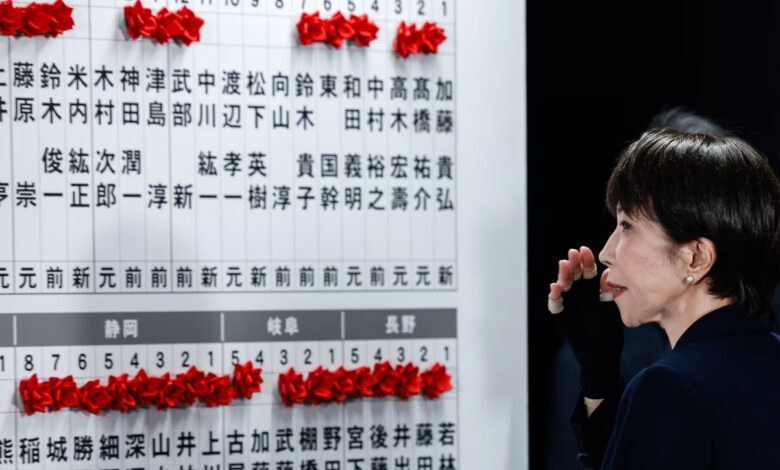
It was a risky gamble to call a snap election – her career was on the line. But now Japan’s Sanae Takaichi is basking in the strongest majority for a Japanese government in more than 70 years.
Here’s how this unapologetic conservative, who Trump has lavished praise on, pulled it off.
In the four months since becoming leader, she had skyrocketed in popularity, galvanized typically-disengaged young voters, and given a fresh new face to the country’s political landscape, which for decades was dominated by older men.
This mass appeal translated to a landslide victory on Sunday, securing Takaichi’s ruling Liberal Democratic Party (LDP) a historic two-thirds supermajority in the lower house of parliament – the first time a single party has done so since World War ii.

It’s a much-needed win for the LDP, which has been working hard to rehabilitate its public image. Though the LDP has historically been dominant in Japan, in recent years it has been weighed down by election losses, stubborn inflation and political scandals. Longtime supporters have jumped ship, viewing the LDP as too old-fashioned and center-leaning, and instead flocked to new right-wing parties.
Takaichi was seen as a potential answer to this problem – though conservativism looks a little different in Japan than in the United States.
Socially, Takaichi opposes same-sex marriage, is in favor of patriotic education, and supports keeping Japan’s single-surname system, which makes it harder for women to keep their maiden names.
She has advocated revising Japan’s pacifist constitution, including the article that renounces war. On Monday, she said she would “persistently work” to revise the constitution, though did not specify which parts she wants to change. It’s still a steep uphill climb; she would need to secure a two-thirds majority in the upper house of parliament, and pass a national referendum on the issue.
Economically, Takaichi backs big government and just passed a record-breaking spending budget. And though she’s a prominent member of an ultranationalist lobby, she isn’t anti-globalist; she’s recently reaffirmed ties with the US, the UK, Italy, and South Korea, despite decades of tension rooted in Japan’s brutal occupation of the Korean Peninsula.
She’s also an unconventional candidate in her country’s normally staid, formal political landscape. She rides motorbikes, plays the drums, enjoys heavy metal, and unlike many of her male peers, doesn’t come from a political dynasty; her father worked for a car company and her mother was a police officer.
Her sweeping victory reflects the public’s desire for LDP reform and the nationwide rightward shift in politics. But it is also a testament to Takaichi’s star power – which has whipped up public enthusiasm to levels not seen for years, especially among young Japanese.
The social media strategy of ‘Sana-chan’
The widespread excitement – dubbed by some media outlets as “Sana-mania” – was evident in the run-up to Sunday’s vote. Thousands of fans huddled against the cold during one election rally in Tokyo last week, all eager for a glimpse of Takaichi.
Much of this success is thanks to a savvy social media strategy, in which she delivers succinct, slogan-ready lines – and shares viral videos of her meeting world leaders, like South Korean President Lee Jae Myung, with whom she jammed out to K-pop hits.
Even small details of her daily life, from the bag she carries to the pen she uses, are closely followed and emulated. In her hometown of Nara, souvenir shops sell towels emblazoned with her slogans, key chains, stationery, even cookies bearing her likeness alongside that of her political idol, former British Prime Minister Margaret Thatcher.
Last week ahead of the vote, two 20-year-old students expressed admiration for Takaichi – who they call “Sana-chan,” using an affectionate suffix usually reserved for close friends.
She’s also won a supporter in US President Donald Trump, who endorsed her ahead of the election and invited her to the White House, even before the results came out.
Her victory, however, is likely to further rattle China, Japan’s neighbor and biggest trade partner. Relations have cratered in recent months over comments Takaichi made about Taiwan, the democratic self-ruling island claimed by China’s Communist Party.
Takaichi broke Japan’s long tradition of ambiguity on Taiwan when she told parliament in November that a Chinese attack on the island – which lies just 60 miles (97 kilometers) from Japanese territory – could trigger a military response from Tokyo.
China retaliated by canceling flights, restricting imports of Japanese seafood and ramping up military patrols, among other measures. It offered another stern warning on Monday, with a Ministry of Foreign Affairs spokesperson describing Japan’s election results as reflecting “deep-seated structural issues.”

“If Japan’s far-right forces misjudge the situation and act recklessly, they will inevitably face resistance from the Japanese people and firm opposition from the international community,” the spokesperson said, urging Tokyo to “retract Takaichi’s erroneous remarks.”
Besides the soured relations with China, Takaichi has a number of other issues to tackle: Japan’s rapidly aging population, the rising cost of living, and a weak yen.
Her policy direction remains unclear for now, and one expert told CNN last week that the effects of her comments “haven’t fully appeared yet.”
But Sunday’s remarkable landslide mean the LDP now has enough seats to override votes in the upper house of parliament, to propose amendments to the constitution, and to chair all lower house committees alongside its coalition partner.
That gives Takaichi a clear path to deliver on her agenda over the coming years – until the next election in 2027.
CNN’s Rae Wang contributed reporting.