The Egyptian archaeological mission from the Supreme Council of Antiquities working in South Sinai has uncovered a new archaeological site of significant importance, the Umm Arak Plateau.
The Secretary-General of the Supreme Council of Antiquities, Hesham al-Leithy, explained that the site is considered one of the most important rock art sites recently discovered.
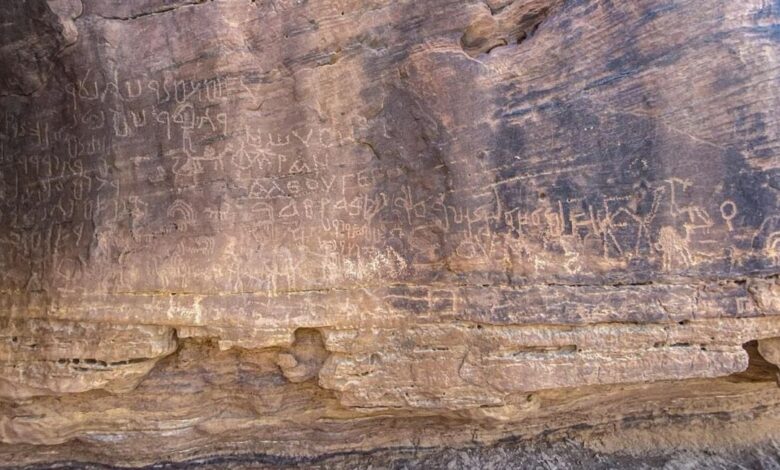
He noted that the chronological and technical diversity of the rock inscriptions on Umm Arak Plateau makes it akin to an open-air natural museum.
The head of the Egyptian Antiquities Sector, Mohamed Abdel-Badi, explained that this discovery came following scientific survey and documentation of rock inscriptions in South Sinai, guided by Sheikh Rabie Barakat, a resident of the Serabit al-Khadim area.
He explained that the Egyptian mission was able to fully document the site, which includes a naturally formed sandstone rock shelter that extends over 100 meters on the eastern side of the plateau, with a depth ranging between two and three meters, while the height of its roof ranges from about one and a half meters to half a meter.
The ceiling of the rock shelter features a large number of rock paintings executed in red ink, depicting various animals and symbols that are still being studied.
Alongside these are another group of grayscale paintings which have been documented for the first time, as well as inscriptions and scenes executed in various styles and techniques, displaying unique artistic richness and cultural diversity.
Thousands of years of usage
The archaeological survey also yielded a number of flint tools, in addition to numerous pottery fragments.
Some of these are believed to date back to the Middle Kingdom, while others date to the Roman period, specifically the third century AD, confirming the site’s continuous use over thousands of years.
According to the preliminary study, the rock carvings and drawings were divided into several time groups, with the oldest group being those executed on the roof of the rock shelter using red paint, which are tentatively dated between 10,000 and 5,500 BC depicting scenes of different animals.
Other groups of inscriptions include scenes of camels and horses in various forms, ridden by figures carrying weapons. Some of these are accompanied by Nabataean inscriptions, indicating later historical periods that witnessed diverse cultural and civilizational interactions in the region.
A collection of Arabic inscriptions has also been documented, representing important evidence of the site’s continued use even during the early Islamic periods and beyond.
Edited translation from Al-Masry Al-Youm