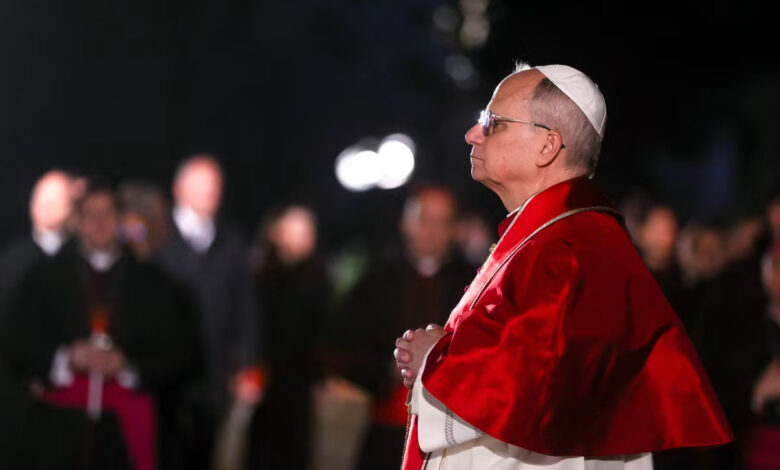
On Monday, Pope Leo XIV’s is setting off on a long Africa trip, the first of his papacy to bear a clear personal stamp.
Between April 13-23, the pope will travel to four countries, crisscrossing a continent pivotal to the 21st-century church he leads. Christian-Muslim relations will be high on his agenda.
It’s a trip that comes as the first American pope is increasingly speaking out against the current conflict in the Middle East, saying God can’t be used to justify war, while Pete Hegseth, the US defense secretary, frames the US war effort as divinely supported. Leo’s decision to visit Algeria, a Muslim-majority nation, and tackle inter-faith relations also points to him becoming a diplomatic counterweight to the Trump administration and its military intervention in Iran.
Trump criticized the pope in a post on Truth Social overnight ahead of Leo’s trip, describing the pontiff as “terrible for Foreign Policy” and saying that “I don’t want a Pope who thinks it’s OK for Iran to have a Nuclear Weapon.” Leo later responded aboard his plane Monday, saying, “The things I say are not meant as attacks on anyone,” but added, “I have no fear of the Trump administration or speaking out loudly of the message of the Gospel.”
Africa is a continent where the Catholic Church is growing, and where the church frequently plays an influential role in civil society through education and healthcare and helping to mediate in conflicts. According to Vatican statistics, Catholics on the continent now make up around 20% of believers worldwide.
Leo XIV, who spent years as a missionary in the global south, knows Africa well. And as pope, he has appointed priests from Nigeria to senior positions in the Vatican.
His itinerary includes Algeria, Cameroon, Angola and Equatorial Guinea and will see him take 18 flights, including two by helicopter, and cover 11,185 miles, or around 18,000 kilometers. That schedule is likely to be tough even for a pope who, at 70, is relatively young and known to take regular exercise.
While the countries he is visiting are diverse, the itinerary and his plans while there point to a consistent theme of Leo as bridge builder and reconciler.
“Pope Leo’s visit to Africa will offer him the unique opportunity to listen to African Catholics and learn first-hand about the realities of their daily life,” said the Reverend Agbonkhianmeghe Orobator, a Jesuit priest from Nigeria who led his religious order’s community across Africa between 2017-2023 and is now based at Santa Clara University in Berkeley, California.
Algeria welcoming ‘one of its own sons’
Leo will begin his marathon Africa visit in Algeria, becoming the first pope to set foot in the country. Mistrust of western culture and Christianity is still high in Algeria, much of it associated with the past French colonial presence, and the country is home to only a tiny Catholic population of around 8,000. Christians there frequently face difficulties.
The pope’s presence should offer a boost to the Algerian Catholic Church, known for working closely with its Muslim counterparts in the country, while highlighting Algeria’s ancient Christian roots.
“(In Algeria) Christianity still carries memories of an oppressive past,” the Reverend Martin McGee, a Benedictine monk and expert on Christian-Muslim relations in Algeria, told CNN.
“Pope Leo will also be seeking to strengthen Christian-Muslim relationships. Since the independence of the country from France in 1962, the tiny remnant of the Catholic Church in Algeria has consistently worked at breaking down barriers between Christian and Muslim believers,” he added.
Bishop Diego Sarrió Cucarella, who leads the diocese of Laghouat in Algeria, told CNN the church in the country is not one of “numbers or visibility” but a “church of presence – unarmed and disarming.”
“In a world often marked by fear or misunderstanding between religions and cultures, our experience here suggests that another path is possible,” he said. “Algerian society has a strong sense of hospitality, and many will recognize in him (the pope) not a foreign leader, but a man of peace – a brother seeking peace with the brethren.”
Leo will also make a very poignant pilgrimage in Algeria by taking a day trip to the city of Annaba, where Saint Augustine of Hippo served as a bishop in the late fourth and early fifth centuries. St Augustine, one of Christianity’s most influential figures, is the inspiration for the religious order of the Augustinians, of which Leo is a member and former leader.

Michel Guillaud, the Bishop of Constantine and Hippo, said Leo had visited Algeria twice before his election as pope, and that the Augustine link provides “a sense of kinship between this pope and the Algerian people” in a country that is “a bridge” between the African continent, the Arab-Muslim world and the “other shores of the Mediterranean world.”
“It is as if Algeria were welcoming one of its own sons, since he is ‘a son of Augustine,’” he told CNN.
A growing, youthful church
The other African countries Leo will visit have large and growing Catholic populations. During his trip, he will see the vibrant church up close, celebrating open-air Masses and visiting nursing homes, a prison, university campuses and a psychiatric hospital. A Vatican spokesman said “600,000 faithful” are expected to take part in a Mass presided by Leo in a carpark adjacent to the Japoma Stadium in Douala, Cameroon.

While in Cameroon, Leo will focus on a message of reconciliation in a country where an English-speaking minority has protested against perceived discrimination by the Francophone government. The pope will go to Bamenda, the largest Anglophone city in the country, to take part in a peace meeting. The meeting will be attended by an internally displaced family, the traditional leader of the Mankon people, which is a prominent ethnic group in the region, a Catholic nun, an Imam and other church leaders.
Bamenda has been at the center of a long-running conflict between government forces and Anglophone separatists, which has killed thousands since 2017, including civilians.

“Much of the world pays little or no attention to the conflict and violence that have crippled socioeconomic life and caused intolerable human casualties in the northwestern and southwestern anglophone parts of Cameroon. His visit to Bamenda is particularly poignant,” said Orobator at Santa Clara University.
“Leo is perhaps the only religious leader with the soft power to convene the belligerent and opposing forces to come to the table of dialogue and seek just peace. It will be a unique occasion for him to remind Cameroonians that there are alternatives pathways to conflict and violence.”
Foreign visits offer the pope a chance to address the country’s leadership and shine a spotlight on certain issues. While in Angola, Leo will fly to the city of Saurimo, the heart of the country’s controversial diamond industry, where he’ll celebrate an open-air Mass.
While the diamond industry is a major contributor to the economy, concerns have been raised about its effect on the environment and the treatment of miners. During his pontificate Leo has talked about the importance of protecting the planet, so environmental stewardship could be a topic he addresses while in Angola and elsewhere in Africa.
“By modeling peace as a ‘humble and disarming’ force, the pope not only draws global attention to the region’s suffering but also positions the African Church as a trusted mediator for reconciliation,” said Jaisy A. Joseph, a theologian at Villanova University, Pope Leo’s alma mater.
Missionary pope
Leo’s Africa trip will see him outside of the Vatican for the longest time since his election, and the constant travel in the country has echoes of his time as a missionary and bishop in Latin America.
It is fitting that he’ll mark the first anniversary of the death of his predecessor, Pope Francis, on April 21 in Equatorial Guinea, a small country with a mainly Catholic population and where around 70% live in poverty. Leo’s visit to the country – the first papal trip since 1982 – will see him put into action Francis’ vision of a church that goes out to the margins, serving the poorest.
The pope’s jam-packed schedule in Equatorial Guinea includes a visit to a prison and an oceanfront memorial for the victims of a series of explosions in 2021 at a military barracks. President Teodoro Obiang and his government said the blasts were the result of “negligence” and a fire begun by farmers nearby, but human rights groups have called for an independent inquiry into the explosions.
From the moment of his election, Leo has sought to offer a leadership that breaks down divisions. His whirlwind visit to Africa will seek to put that vision into action on the continent.
This report has been updated with additional developments.