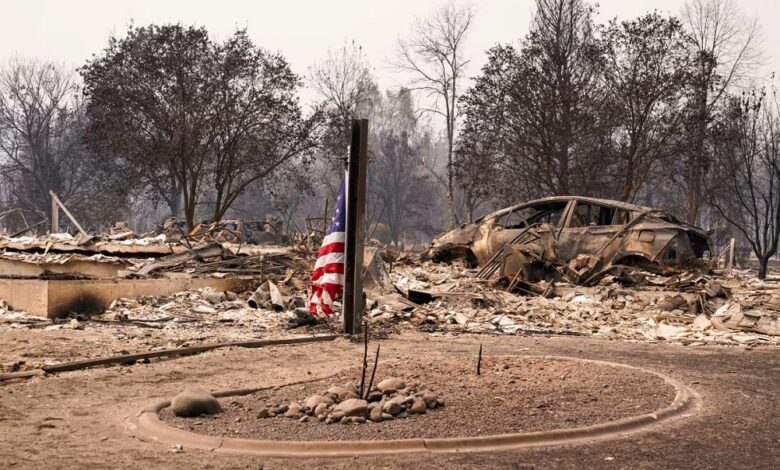
Destructive wildfires are part of life in much of the US now, as Americans adapt to the warming planet and its more intense weather starts to feel common.
This summer, Spokane, Washington, most notably saw neighborhoods decimated and tens of thousands face evacuation. But wildfires affected much of the Western US, leveling homes in Utah and Colorado, among other states, to say nothing of the frightening pictures out of Europe and the smoke that has poured into the US from Canada.
President Donald Trump, who has described climate change as a “hoax,” has withdrawn the US from international efforts to address the issue and slashed domestic efforts to counter it, wondered last month if Canada should pay the US damages for smoke that has “poisoned” US air, as if Canada could control either the air flow or the fires any more than the US.
His EPA has all but dismantled an office that was researching the effects of smoke on humans, according to the New York Times.
In recent years, Texas, Tennessee, Florida, California and Hawaii, among other states, have seen homes destroyed and lives uprooted. Fires rage each year in forestland across the West.

It will be harder to assess the cost of these disasters, along with other climate-related weather events, after Trump’s administration stopped tracking them as a result of cuts at NOAA, the National Oceanic and Atmospheric Administration — although a nonprofit has tried to fill the void. Wildfires in Los Angeles early in Trump’s second term cost an estimated $63 billion.
Trump has also moved, without approval or funding from Congress, to completely reorganize the sprawling patchwork of agencies that deploy wildland firefighters in US by creating the new US Wildland Firefighting Service. That may be a worthy ultimate goal, but Congress wants him to slow down and study the issue, and has refused to fund the agency as Trump’s administration envisions it.
Those DC disagreements aside, wildfires continue to spread.
I talked to Brandon Miller, CNN’s lead meteorologist and the network’s climate crisis beat leader about this year’s fires, fires in general, what to expect in the future and what communities can do.
Our edited conversation is below.
How does this fire season compare?
WOLF: The big headlines this summer have been from Spokane, Spain, and France. How is this fire season compared to others so far?
MILLER: It’s above average pretty much everywhere we look. We’re about 50% above normal for the amount of area that has burned across the US up to early August. That’s 50% above normal over the last 10 years. The last 10 years has already been above normal.
If you compare that to a couple of decades ago, that’s already increased by probably 50%, just the baseline. So we just continue to march ever upward when it comes to the amount of area burned.

What’s going on around the world?
WOLF: How do the US fires compare to worldwide fires?
MILLER: It’s certainly not exclusive to the US and it’s even worse in other locations, places like Canada that are above average this year by a good margin and the last four years are each of their top four years as far as burned areas. This is just an annual thing now.
I’ve been covering global weather here at CNN for 20 years, and every year somewhere in Europe is burning, and it’s and it’s more than we’ve seen before. Last year it was Greece and Italy. This year, it’s Spain, it’s France, it’s the UK. Pretty much everywhere in Europe is setting temperature records each summer.
Here in the US right now, Oregon and Washington lead the lead the nation in the number of large fires. California isn’t yet, but there’s plenty of time for that to change. Many years, California and Colorado are leading. The exact locations may change from year to year, but the overall area burns, the overall number of fires, all those things continue to march upwards.
The season is now never-ending
WOLF: Is there something about preparation or preparedness in California that was different this year so far, or have they just been lucky?
MILLER: Not necessarily lucky. Their fire season tends to come later in the year. Into autumn is when they get more of those big windstorms, those Santa Anas that you’ve probably heard of. Strong wind events can really dry out those fuels. They don’t really get rain there over the summer. and so that’s when things really start to dry out. By the time the winds arrive in the fall, that’s when they see a lot of their big fires. Oregon and Washington aren’t typically areas that get as dry and hot. A lot of those places, especially there along the Pacific, don’t even have air conditioning. But when they’re having days and days of 90- and 100-degree temperatures, that’s indicative of something way different than what used to be. When you see those temperature records, it is very likely fire is to follow.

What can (and can’t) be blamed on climate change
WOLF: The Spokane Fire was allegedly set by an arsonist. If that’s the case, is it appropriate for us to attribute climate change to that in any way?
MILLER: Yes and no. People have always caused fires, whether purposefully or, most of the time, it’s an accident. A campfire could ignite. Starting your car on dry grass can ignite a wildfire. Humans have always caused fires, and the percentage of human versus natural causes hasn’t really changed much in recent years. To say that climate change caused the Spokane fires — no, absolutely that would be an incorrect thing to say.
But did it prime the area to burn in the way that it did? Absolutely.
What’s the recipe for a wildfire in this climate change era?
WOLF: What are the ingredients that make for increased wildfire risk and why are they turbocharged by climate change?
MILLER: It’s not so difficult to think about. The drier something is, the more likely it is to burn. The hotter something is, the drier it gets. Climate change is changing the atmosphere’s thirst. It’s causing evaporation to happen more quickly, and that lowers water levels. In the western reservoirs we’re seeing record lows at Lake Mead and Lake Powell. It also is removing water from trees, from brush, from forests, and that makes them more likely to burn.
The flip side of that is, if everything just got drier and drier continuously, some of these areas would become deserts and after a long time, wouldn’t burn so much.
But the problem is this weather whiplash that we see — and we see this a lot with California, where they’ll go from a really wet year to a really dry year. So you get a really wet year, maybe some of the climate patterns that are naturally occurring, El Niño and La Niña. Ironically, climate change also makes wet patterns wetter because warmer air, as the climate warms, can hold more water in it. So you might get a very lush year that grows a lot of vegetation, and then when the next year comes and it’s the hottest and driest on record, it doesn’t take a degree in climatology to figure out that’s going to be a really bad burn year. That’s what we’re seeing. That’s what’s happened in Europe as well. They had a very wet winter, and this summer has been the hottest on record by a good margin. And so that’s setting the table for a really bad fire situation.

Why wildfires rage in wet places
WOLF: Dryness and fire danger on the West Coast makes sense. But there were fires in Hawaii recently. Earlier this year, there were bad fires in Florida. Is there anywhere that’s immune from this?
MILLER: I wouldn’t say anywhere is immune. Certainly, anywhere that has forests and wildland is subject to those burning. Here in the Southeast, we had Gatlinburg a few years back, where there was really bad fire. That opened a lot of people’s eyes to, this isn’t just a West Coast problem.
The Great Lakes and some of the interior Northeast probably sees the lowest incidents. Florida surprises a lot of people because they get so much rain, but when the rain shuts off, even for just a short amount of time, it’s so hot that things dry out very quickly. They also have the most lightning per square mile of anywhere in the country. Lightning is one of the No. 1 causes of fires. Just a couple weeks of no rain and really hot temperatures followed by a thunderstorm in Florida can ignite dozens of fires.
Desirable living areas can mean more fires
WOLF: What made the Spokane Fire so destructive is that it entered developed communities. That’s happened across the country now. Is there a documented increase in this crossover between wildfires and civilization? What is causing it?
MILLER: It’s actually a very active area of research. It’s known as the “wildland-urban interface,” and there are millions of people in the US alone that live in what would be classified as a wildland-urban interface. As we’ve built out cities, we are infringing upon what was before wildlands or forests. These are desirable places to live. Just like living on the coast, even though it’s very vulnerable to hurricanes, is a desirable place to live for obvious reasons. But what that does is it butts up into nature, and nature naturally burns.
The natural burning process of forests is actually a good thing, which is why we have prescribed burns and things that are designed to make the forest healthy. It keeps the forest healthy and clears it of that growth. The other thing with the wildland urban interface — those forests aren’t necessarily maintained as well as they could have or should have been, because those prescribed burns are burns. They’re fires. People don’t like those fires. They don’t want to have some of their nicest days the summertime full of smoke. Forest management runs against that all the time.
Also, you can’t do a prescribed burn if the conditions are dangerous. They want a day with low fire danger, with a lot of moisture in the forests. But those days, a lot of years, just aren’t very plentiful. So it’s getting harder. Climate change is working against that as well. That may be something governments are going to have to do more of or do differently.

What homeowners can do
WOLF: What else do they need to be doing, and what are they doing to address this as in terms of prevention?
MILLER: A lot of that, you know, can be managed on the development side — making houses in a more fire-sustainable way that going to give natural fire breaks. Not having as flammable materials, not having landscaping in your yard that that is vulnerable to fire. There’s a lot of things that homeowners themselves can do, just at an extremely local level to maximize their home or their neighborhood’s chances to survive a fire.
WOLF: What’s a fire break? Not putting houses right next to each other?
MILLER: Don’t put houses right next to that forest, really, is the thing. You want to have that natural break. With the wildland urban interface, they’re trying to figure out exactly how much needs to be there, what they can put in those locations, because once one house burns in a in a neighborhood, if there’s any wind at all, it’s going to go from house to house to house to house very quickly. The wind carries those embers extremely efficiently, and just a couple of those landing on a roof can quickly lead to a house burning.
What climate scientists and firefighters are saying
WOLF: Climate science predicted there would be more and more intense fires. That is happening. What do climate scientists think will happen next?
MILLER: More of this exactly. More of the burned area increasing. It’s because the fire season is increasing. It’s starting earlier and it lasts longer. If you look back at Canada, for instance, it never really started burning there until June or or July, because there was still snow on the ground until quite late. It took months to really dry out and heat up. But now it’s happening on both ends. You get less snow in a lot of years, so it melts quicker, and that exposes that vegetation. It’s growing sooner, and then drying out sooner, and then it’s taking longer for the snow to come back, and the rains and the cooler temperatures. Especially in some of those higher-latitude areas — Canada, Europe, Russia — where we’ve seen the worst and the most fire activity, we do expect that trend to continue.
I’ve talked to a lot of wildland firefighters in recent years, and the one thing they talk about so much — those firefighters tend to be a fairly conservative bunch, not ones that you would typically expect to talk about environmental, climate change, things like that. But they have no doubt, because they’ve seen it in with their own eyes how things have changed, and the thing they point to the most is nighttime recovery.
Nighttime was always their time to fight these fires. Even the most aggressive fires, they might have to come back, retreat a little bit during the day, but at night they would be able to really attack these fires and hopefully get them to a good place ahead of the next day when it would get hot and the winds would pick up in the afternoon. It basically doesn’t happen anymore. Just like the fire season has grown to a fire year, the fire day is now 24 hours. There’s less time or ability to really gain ground on these fires, and that’s why sometimes they can grow so exponentially, even in the overnight hours.