Xi made the comments at a landmark speech marking the centenary of the birth of one of his predecessors – Jiang Zemin, who was China’s leader from 1993 to 2002. He died in 2022.
Addressing thousands of officials and delegates at the Great Hall of the People, Xi portrayed China as a country that was facing tough times, but one that would emerge unscathed.
“With an indomitable fighting spirit and exceptional capabilities, we will actively confront major challenges, whether they be rough seas or even raging storms,” he said.
“(We must) resolutely defend our national sovereignty, security, and development interests, thereby writing a new chapter in the two great miracles of rapid economic development and long-term social stability.”
In an indication of the speech’s importance, all seven members of China’s powerful politburo standing committee, along with retired party and state leaders, were all present, according to state TV footage.
Student crackdown
Jiang’s rise to the top began amid the tumult of the 1989 Tiananmen Square democracy protests, which were brutally crushed by Chinese troops in what remains one of the most sensitive political taboos in mainland China.
In the 45-minute speech, Xi praised a long list of Jiang’s achievements, including a rare mention of the Tiananmen democracy protests, hailing the Communist Party’s ultimate decision to reject the protesters’ demands and clear the square using troops and tanks.
“In between of the spring and summer of 1989, China experienced a serious political upheaval, Comrade Jiang Zemin resolutely supported and implemented the Central Committee’s correct decisions, effectively maintaining stability in Shanghai,” said Xi.
The protests first began in April, triggered by the death of former Chinese Communist Party leader Hu Yaobang at the age of 73. Seen by the public as a champion for liberalization, Hu had been deposed two years earlier and his death on April 15 was widely mourned.
Days later, thousands of grieving students marched through Beijing, calling for a more democratic government in Hu’s honor. Protesters gathered in Tiananmen Square, their numbers building over several weeks until June 4, when People’s Liberation Army troops fired on them.
Jiang unexpectedly became General Secretary of the Communist Party shortly after the crackdown in part because the person he replaced, Zhao Ziyang, was seen as being unduly sympathetic to the protesters. By 1993 he was the undisputed leader of China.
Jiang’s contribution to support party rulers’ decision to clamp down on protesters was also mentioned in a 12-episode documentary that aired on state TV last week to commemorate Jiang’s life, but it did not show any footage of the killings that shocked the world. Those images are routinely scrubbed from China’s heavily censored internet and discussion of what happened remains fraught with risk to this day.
Jiang’s era saw China’s economy charge ahead and open up to the world, culminating with the country joining the World Trade Organization – with US support – in 2001.
A period of intense economic growth followed, with improving relations between the US and China. However, in recent years bilateral ties have plunged, marred by frequent tit-for-tat trade tensions and growing geopolitical rivalries.
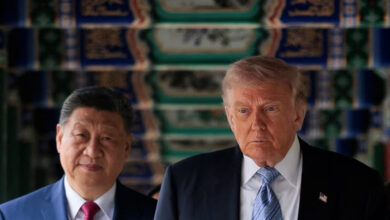
Xi’s second meeting with US President Donald Trump is scheduled for late September, when the two leaders are expected to discuss trade ties, artificial intelligence and Taiwan, among other issues.
In his speech Monday, also broadcast and published by state media, Xi talked up the nation’s accomplishments, saying that “people’s lives continue to improve,” even as data shows slowing economic growth.
“The prospects for the great rejuvenation of the Chinese nation are bright, and the dream for which several generations have strived with unwavering determination is gradually becoming a reality,” he added.