Bear attacks in Japan have hit a record high, with 13 deaths and more than 220 injuries recorded between April 2025 and March 2026. It is a sharp increase from the same period the previous year, when three people died and 82 were hurt, and as fall approaches, the bears’ peak feeding season, authorities are on high alert.
The rise in human-bear encounters in Japan can be traced back to shrinking rural communities following the World War II when millions of young people began moving to cities. “With the loss of farmland that once buffered settlements from bears, the boundary between towns and forests became more blurred for them,” explained Liam Adcock, a wildlife researcher at the Nagano-based Picchio Wildlife Research Center.
He added that tighter hunting restrictions and a shrinking hunter population have allowed Japan’s two native bear species — the Hokkaido brown bear and the Asiatic black bear — to grow. It is estimated that there are more than 57,000 bears in the country.
Climate change has made the problem worse: vegetables, berries and acorns, which the bears rely on, are growing later in the season and becoming more scarce, Adcock said. “But they know that one food source remains unchanged: human rubbish.”
This has brought hungry bears closer to towns than ever before, with 50,000 recorded bear sightings last year.
In a 2026 environment white paper, the government described the animals as “a serious threat to public safety and peace,” while easing bear hunting rules and introducing a population control roadmap. The plan aims to reduce the bear population to between 62% and 67% of current levels across a number of prefectures by 2030, through culling.
Adcock said that while there is still a general cultural preference for coexistence, the priority has shifted to ensuring immediate public safety and responding efficiently to threats.

“Often, fireworks are set off in towns to scare off bears,” said Adcock. “But when it’s not enough, the police or military is deployed, which is often synonymous with euthanizing the bears, especially if it’s during the day and there’s people around.”
“We want to show that coexistence through nonlethal management, including technology, is perfectly achievable,” he added.
High-tech alternatives
Regions prone to bear encounters, such as Gunma, Toyama and Ishikawa, have started equipping forests surrounding residential areas with movement-monitoring cameras that use AI to identify bears and notify local officials. The system, developed by Hokuriku Electric Power Company along with communications systems company Hokutsu, has allowed authorities to issue warnings to locals and take action to drive the bear farther away from town, according to reports.
In Hokkaido, KDDI SmartDrone set up a drone port in the town of Shintotsukawa that can get a drone airborne within 10 minutes of a bear sighting, tracking the animal until help arrives. Nonlethal methods are usually prioritized to drive the bears away.
AI and drones are “very efficient for detection, and quite helpful for deterrence,” Adcock said. The technology has also proven effective elsewhere in the world, such as the US, where a small 2024 study found that drones in Montana successfully hazed bears away from human habitations 91 percent of the time.
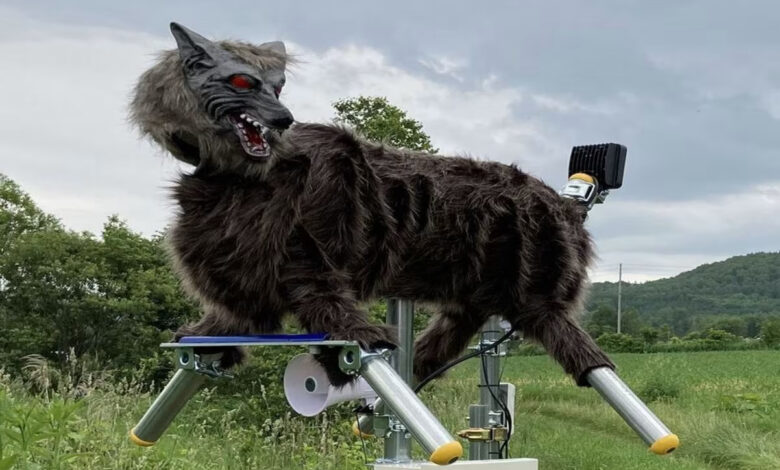
But the technology isn’t practical for individuals looking to keep bears off their property. That’s where the solar-powered, animatronic “Monster Wolf” comes in. The $4,000 robot was originally developed to protect agricultural crops from bears by mimicking the howl of the extinct Japanese wolf to scare them away.
Motohiro Miyasaka, the managing director of Wolf Kamui Co., the company marketing the robot, told CNN that its sales have doubled “following the frequent sightings of bears in urban areas in Japan since last year.”
The company is developing a portable 8-inch plush version, for those “who enjoy stream fishing, camping and hiking,” Miyasaka said. “The Monster Wolf Mini will be tested around the end of 2026.”

However, these systems aren’t a silver bullet according to Tokyo-based engineer Danyel Koca. “The use of AI, drones and robots costs a lot,” he told CNN. “They’re not easy to build, to use and to scale nationally.” He added that they are lifesaving in certain cases, but do not provide immediate information for locals and hikers.
In August 2025, a fatal bear attack on a hiker on Mount Rausu in Hokkaido prompted Koca to look into bear incident data across the country. “There was no single, practical place to check the risk,” he said. “Japan already had a lot of bear information, but it was spread across many local sources. Prefectures and municipalities published reports in different formats: PDFs, local maps, Excel files, press notices, and Japanese-only pages. That made it hard to check one route or one destination.”
He decided to make public information usable before people go outdoors, and founded Kumamap, a bear incident tracker. Using local government data, national news, and verified community reports, Koca argues that the app supports coexistence. “If people understand the risk, they can prepare better and avoid surprise encounters,” he said. “Kumamap is helping people make better decisions in bear habitat.” As of early August, the app had nearly 6 million users and has tracked 156,631 public bear incident records, including 821 reviewed community records.

Traditional deterrents
Adcock recognizes the potential of technology for bear conservation but emphasizes that people on the ground are almost always needed to deal with the issue.
That’s why Picchio Wildlife Research Center recommends using Japan’s original “deterrent technology”: bear dogs. “Japan used to (raise) semi-wild dogs (which naturally would) chase bears away from the city,” Adcock said, adding that his organization uses Finnish Karelian bear dogs to reduce human-bear conflicts by tracking, barking at, and chasing bears away from residential towns without harming them.

“Despite bear encounters having almost doubled from last year, the towns we work with had the lowest records of bear encounters in a long time,” he said. “The method works, and we hope more regions and countries will look at it. Generally speaking, the way Japan is efficiently implementing new technology and nonlethal methods like bear dogs is something other countries can learn from.”