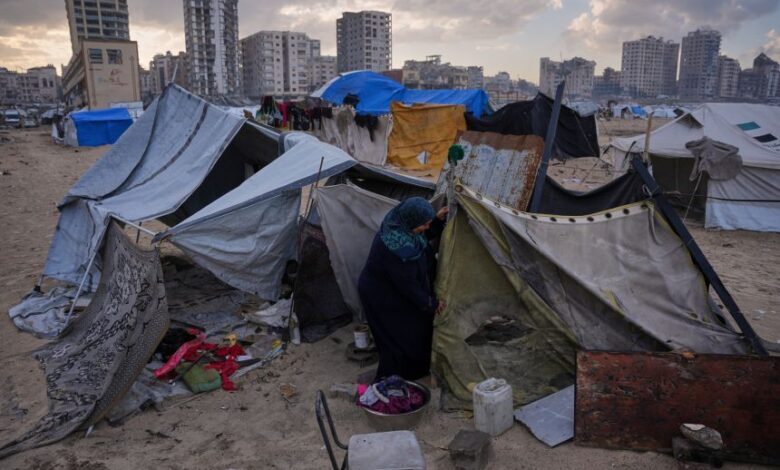
Palestinians in Gaza face an impossible choice this winter. With more than 400,000 homes destroyed in the war, Gazans are being forced to choose between living in tents exposed to the elements or run the risk of living inside the ruins of buildings that could collapse any minute.
Hiyam Abu Nabah has no access to a tent; so that terrible choice has been made for her. She lives with her family in the shell of a building in the Hamad area of Khan Younis, southern Gaza, with no walls to protect them from the elements and the upper floors of the building pancaked above them.
Last week, torrential rains and floods killed at least 17 people in Gaza, including children, Palestinian Civil Defense Spokesperson Mahmoud Basal said. Others, he said, died due to building collapses. More than 90 residential buildings were affected and approximately 90 percent of shelters for people displaced due to Israel’s war in Gaza were completely flooded.
“On the first day of the storm, we could hear the stones cracking above our heads,” Abu Nabah says. “Sand was falling into our eyes… this is not a life.”
She watches her five-year-old weave in-between electrical wires hanging down from the crumbling ceiling. The wires are now used to hang clothes to keep them off the wet floor; electricity is but a distant memory here.
Her dream of moving back to what is left of her home in Shujaiya, Gaza City, seems remote. It is behind the so-called “yellow line” in an area occupied by the Israeli military as part of the ceasefire agreement to end the two-year war, inaccessible to residents.
In a building nearby, Awn Al Haj pokes at the roof of his shelter with a stick to show stone and sand crumble and fall at his feet. But this roof is the collapsed foundation of the apartment above, twisted steel girders distorted by the pressure of so many stories pancaked above.
Remembering a recent storm that passed through, Al Haj says “three days of it were like the early days of the war… you did not know what (would) happen to you while you are sitting here. Concrete blocks fall, water leaks in, wind and bitter cold.”

Every building still partially standing in this neighborhood carries the same dangers. Shoring up crumbling walls with mud, covering gaping holes with tarpaulin, Al Haj knows this is a band aid solution to a life-threatening problem.
The only alternative, he says, is to sit by the sea, in a tent, inundated by water.
Further north, in the al-Shati camp, a building collapsed Tuesday, killing a man sitting inside and injuring two others. One of the neighbors said it was badly damaged when the building next door was destroyed in an Israeli airstrike; the winter weather and wind was the final straw. “Houses keep collapsing. Someone do something about how we are living,” the neighbor said. “Day after day a house falls, day after day people die.”
Mohammad Fathi of the Gaza Civil Defense, which acts as the emergency service, was on the scene to recover survivors. Fathi says they do not have heavy machinery, such as excavators, to help them rescue survivors trapped under collapsed buildings. “With every winter storm, many families and many children will die,” he warned.
The Civil Defense calls for people to move out of damaged buildings during heavy rain, but the advice falls on deaf ears. For those living amongst the rubble, there is no other choice. The Civil Defense also states tents are simply not adequate as shelter for a Gaza winter. But there is no other option.

The United Nations says 1.3 million Palestinians need urgent shelter this winter. The latest figures from COGAT, the Israeli agency responsible for allowing goods into Gaza, says they have taken in close to 310,000 tents and tarpaulins recently along with over 1,800 trucks of warm blankets and clothing.
The UN and international NGOs are unanimously calling on Israel to allow more aid into Gaza to help hundreds of thousands without a home survive the winter. The UN says it is blocked by Israel from directly bringing aid into Gaza.
Officials say among those killed due to weather conditions last week was a two-week old baby and an eight month old, both of whom died of hypothermia.
With about 90 percent of shelters for displaced people flooded from recent storms, even more families will now be forced into the precarious, gravity-defying shells that were once homes and apartment blocks.
Bakr Mahmoud al-Sheikh Ali says there have been building collapses in his neighborhood in Khan Younis. “People are afraid, but they tell you, brother, I need shelter, I do not want a tent and water in the winter, in this cold weather… whatever happens, happens.”
The overwhelming sentiment given by every displaced Gazan who spoke to CNN: this is no way to live.
Mohammad Al Sawalhi and Tareq El Helou contributed to this report.