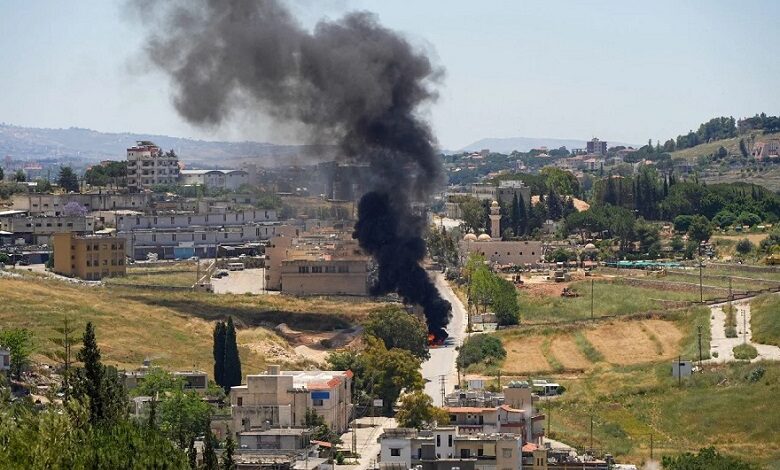
Amnesty International on Wednesday issued an official statement warning that the Israeli army’s repeated use of mass evacuation and non-return orders to forcibly displace and terrorize hundreds of thousands of people in Lebanon is a flagrant violation of international humanitarian law.
These orders have been used as a deliberate tool to forcibly displace civilians from their homes and subsequently prevent tens of thousands from returning – which amounts to an unlawful transfer that, as a grave breach of the Fourth Geneva Convention, constitutes a war crime.
The Amnesty International statement:
In a new investigation combining analysis of Israeli military orders issued to residents of Lebanon via X since 2024, interviews with people displaced from Israel’s unilaterally declared no-return zones, and open source analysis, Amnesty found that the Israeli military radically expanded its use of mass displacement in Lebanon in 2026, subjecting far more residents, far more often, to a flood of unlawful mass “evacuation” orders, while it furthered its plan to destroy more homes and civilian infrastructure and depopulate large parts of the south.
Amnesty’s analysis indicates the Israeli military significantly expanded the scale of its use of mass “evacuation” orders, issuing them more frequently and across larger areas of the country during the 2026 escalation compared to in 2024.
In response to Amnesty’s questions, the Israeli military denied it was issuing mandatory evacuation orders, claiming it issued “advance warnings to civilians” and that these were not mandatory orders but “recommendations”.
Amnesty has previously explained why mass “evacuation” orders do not constitute effective advance warnings and distinguished between such warnings, issued ahead of an attack [pursuant to the principle of precaution] with respect to a specific location like a building, and mass “evacuation” orders, issued to lists of villages and large swathes of land, in its analysis.
The Israeli military claimed in its letter “there is no prohibition on Lebanese civilians returning to their homes”, but on 15 June, after reports that the US and Iran had agreed on a ceasefire including Lebanon, Defense Minister Israel Katz said that Israeli forces “will remain in the security zones in Lebanon, Syria and Gaza without any time limit,” and that these zones would be “cleared of local residents and all terror infrastructure…including the houses in the contact-line villages that served as terror outposts…”
In addition to its mass “evacuation” orders, the Israeli military has also expanded the area of Lebanon subjected to its no-return orders.
On November 28, 2024, the day after a previous ceasefire went into effect, the Israeli military designated an area covering roughly 4.6 percent of Lebanon a no-go zone.
In 2026, just three days after the April 17 ceasefire was announced, the Israeli military published a new map showing an expanded area covering six percent of Lebanon’s territory – designating it what they called a “Forward Defense” zone and told people not to return to a long list of villages inside the zone. The area was previously home to tens of thousands of civilians.
The Israeli military is deployed in the no-return zone and has, since 2024, carried out extensive destruction within it.
Amnesty previously documented how the Israeli military left a trail of deliberate destruction in parts of the no-return zone both before and after the 2024 ceasefire went into effect.
By 2026, Sentinel 2, 10-meter resolution imagery showed almost full-scale clearing of almost all the municipalities along the border, which make up a large portion of the no-return zone, that Amnesty previously analyzed in 2024.
Previously, isolated structures and sections of villages may have been left intact.
Now, almost all of those have been leveled and the heavy destruction has expanded to municipalities further within the no-return zone.
International humanitarian law strictly prohibits the forced displacement of civilians. Partial or total evacuations of civilians may be ordered only as an exceptional measure to ensure the security of the population or for imperative military reasons – arising directly from military operations – and must be used as a measure of last resort.
Any evacuation must be temporary, conducted in safe and humane conditions, and evacuees must be allowed to return to their homes as soon as hostilities in the area in question cease.
Where civilians are forcibly displaced in absence of lawful grounds for evacuations, or are prevented from returning to their homes, this amounts to the grave breach of unlawful transfer under article 147 of the Fourth Geneva Convention, which is a war crime.
Statement from Amnesty International Middle East Regional Director:
The Deputy Regional Director for the Middle East and North Africa at Amnesty International, Kristine Beckerle, said: “In large parts of southern Lebanon, Israel’s ‘everybody-leave’ orders were followed by ‘don’t-come-back’ orders. Israel’s forced displacement and prevention of return of tens of thousands of civilians from southern Lebanon amounts to unlawful transfer, which is a grave breach of the Fourth Geneva Convention and thus a war crime.
Beckerle explained “Instead of forcibly uprooting communities and designating entire swathes of Lebanese land as no-go zones for civilians, Israeli forces must immediately withdraw from Lebanese territory. Those displaced must be allowed to safely and freely return to their lands, and Israel must provide reparation for victims of its international humanitarian law violations, including those whose homes Israel unlawfully destroyed.”