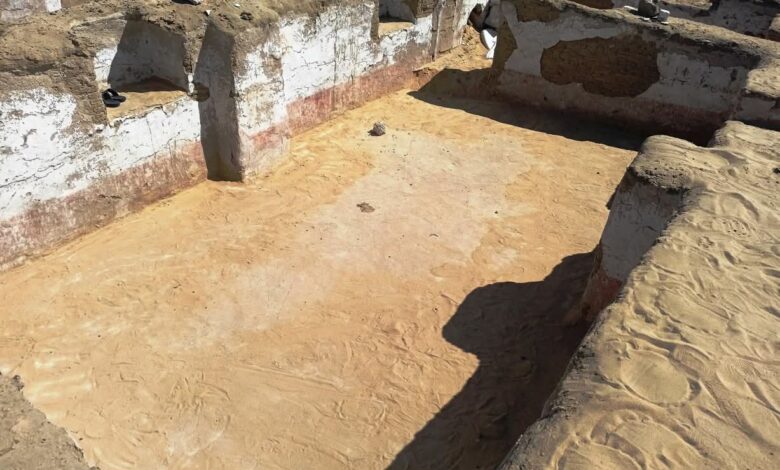
A joint Egyptian archaeological mission from the Supreme Council of Antiquities and the Faculty of Archaeology at Cairo University has unearthed the remains of an ancient monastery dating back to the period between the fourth and sixth centuries AD.
The new discovery is located in the area of buried monasteries in Wadi al-Natrun, al-Beheira Governorate, considered one of the most important centers for the origins of monasticism in Egypt and the world.
This discovery represents an important stage in the development of early monastic life, shedding light on the architectural planning of the first monasteries in this region of great religious and historical significance.
The discovered building covers an area of approximately 2,000 square meters and is constructed of mud bricks.
The outer walls are up to one meter thick, while the inner walls range between 60 and 70 centimeters in thickness and between 1.80 and 2.20 meters in height.
Details of the finding
The building features a central open courtyard at the heart of the overall plan, surrounded by a group of architectural units, including smaller courtyards opening onto monks’ cells of varying shapes and sizes, ranging from square to rectangular.
Service annexes were also uncovered in the western part of the building, including fully equipped kitchens, ovens, and storage areas for provisions.
Excavations uncovered several burial chambers within the building containing human remains, likely belonging to monks of the monastery, highlighting the monastic funerary practices during that period.
Architectural studies revealed the use of various roofing systems, including vaults and domes constructed of mud bricks.
The walls were covered with a layer of white plaster and decorated with murals featuring crosses, palm trees, and various floral and geometric motifs.
Several inscriptions in Coptic script were also found, including the names of monks who resided at the monastery, along with religious texts invoking mercy and forgiveness.
These inscriptions aided in dating the building and documenting the daily lives of the monks.
An important discovery
Minister of Tourism and Antiquities Sherif Fathy said that the discovery represents a significant addition to our understanding of the beginnings of monasticism in Egypt, which originated in Egypt and spread throughout the world.
He added that Wadi al-Natrun is one of the most important spiritual and historical centers in Egypt, and this discovery enhances its position on the international religious and cultural tourism map.
The head of the Islamic and Coptic Antiquities Sector, said that the building is a complete model of early monastic buildings, preserving most of its architectural elements.
The head of the archaeological mission, Yasser Ismail Abdel-Salam, explained that this discovery represents important material evidence confirming historical accounts of the origins of monasticism in Wadi al-Natrun, noting that the building reflects a transitional phase in the development of monastic architecture between individual cells and large monasteries.
Edited translation from Al-Masry Al-Youm