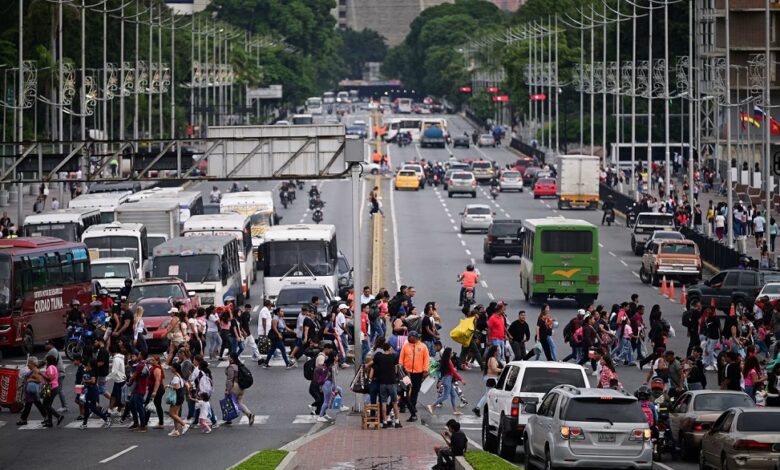
The streets of Caracas are decorated with Christmas lights. The sound of traditional Venezuelan Christmas music can be heard everywhere. Daily routines seem undisturbed: children attending school, adults going to work, vendors opening their businesses.
Beneath this facade lurks anxiety, fear, and frustration, with some even taking preventative measures against a possible attack amid the tension between the United States and Venezuela.
A woman who asked to be identified as Victoria for fear of reprisals has lived alone in western Caracas since her two children left the country and currently works in commerce. She describes her routine in recent months as marked by uncertainty, with each day bringing unsettling developments that rob her of peace of mind.
Although she hasn’t stopped doing her daily tasks, Victoria confesses that this state of alert, with the constant question of what might happen next, has disrupted her sleep.
Sometimes, she says, she gets up in the middle of the night and starts checking the news on her phone, even though she acknowledges that doing so makes it harder to fall back to sleep.
“There’s a confrontation in which we, ordinary citizens, have nothing to do,” she says, referring to the potential conflict between her country and the Trump administration. “We try to carry on with our daily lives, we try to carry on with our daily activities, but that’s always interrupted by the whole situation we’re experiencing, which undoubtedly affects us.”
Victoria says she has to take natural sleeping pills to fall asleep, that she doesn’t want to talk to anyone, and that she’s even experienced physical discomfort as a result. “Only those of us in these shoes feel it,” Victoria says.
Venezuelans are “hardworking, good-hearted people. They don’t deserve everything that’s happening to us,” she says.
Emotional impact
The prolonged political tension between Venezuela and the United States has affected the mental health of Venezuelans in recent months, according to Yorelis Acosta, a clinical and social psychologist and research coordinator at the Center for Development Studies of the Central University of Venezuela.
“There is no single way to process what is happening to us,” she says.
Acosta explains that how each person perceives and deals with the crisis depends on where they live and their connection to their surroundings, among other factors. “It’s not the same for a Venezuelan from Táchira or Zulia, who lives on the border, as it is for someone from Caracas.” She adds that one must also consider those who are outside the country, many of whom feel that Venezuela “is at war or completely militarized,” when the reality is quite different.
According to Acosta, perceptions also vary between those who prefer to stay out of the issue and those who are hyperconnected, sometimes misinformed, or over-informed, and suffering from high levels of anxiety and insomnia.
She recommends maintaining a healthy relationship with the news and social media to avoid information overload. “We need to stay informed, yes, but from reliable sources and for a limited time. We can’t spend all day hyperconnected. We also need to take breaks, move around, breathe, and prioritize physical and mental well-being,” she says.
Some people, like Yanitza Albarrán, focus on maintaining a routine and peace. While participating in a march supporting Venezuelan President Nicolás Maduro on December 1, Albarrán told CNN that she was committed to freedom, peace and the Bolivarian revolution, which she says the president represents.

“Mothers are taking their children to school, women are going out to work, teaching at universities. Farmers are planting, merchants are selling. Our country is at peace because our President Nicolás Maduro and the entire National Armed Forces guarantee it,” she asserted, before rejoining the march. That day, to the rhythm of “No war, yes peace,” the president’s slogan, several people marched, supporting the government’s position: normal life, untouchable Venezuela.
But not everyone is experiencing the moment like Albarrán, and the arrival of Christmas is adding to the economic and political tensions. “For some, December is a reason to celebrate. But for others, it is a reminder of absences. Many miss their relatives who are abroad or face the loss of loved ones,” says Acosta.
And the feelings become even more complex in an increasingly isolated Venezuela.
Preventive measures
Fear has also led to concrete measures.
CNN has obtained notes from some private schools in Caracas, asking parents and guardians to submit an “individual emergency kit” for each student who will be attending school during the year. The kit must contain water, non-perishable food, hygiene items, and medications, if necessary, as well as flashlights.
The rationale is that such kits could be needed in case a student has to spend the night at school, especially in the event of an earthquake. However, a parent who spoke with CNN and requested anonymity for fear of possible repercussions believes the request is meant to prepare for other scenarios related to the tensions between Caracas and Washington.

Since the US started attacking vessels in the Caribbean and Pacific on September 2, Trump has repeatedly hinted at the possibility of an operation in Venezuelan territory, although it’s not clear whether this will materialize or when it might occur.
This climate of uncertainty has led some companies to take other preventative measures. Some business owners who spoke with CNN, and who wished to remain anonymous for fear of reprisals, said they are constantly monitoring road conditions in different parts of the country to ensure their products are distributed, and are conducting communication drills with their employees to alert them in case of any extraordinary situation.
Anxiety compounded by isolation
Several airlines suspended their flights to and from Venezuela after the US’s Federal Aviation Administration on November 21 urged aircraft to exercise extreme caution when flying over the country and the southern Caribbean, citing a potentially dangerous situation. Venezuelan authorities, after giving these airliners 48 hours to resume operations, decided to revoke their flight permits in the country.
When Victoria read that news, she felt “a complete collapse” and “the deepest sadness.”
The announcement nearly buried the possibility of visiting her daughter in France, something she hasn’t done in two years.
“I felt like the world was crashing down on me when I heard the news,” she confesses, adding that she feels fear in seeing the country becoming increasingly isolated. She is still exploring travel options via Colombia, Panama or Curaçao to reunite with her family, though she is also worried she might be taking a risk by traveling under the current circumstances.
Although December is usually the ideal time to see loved ones, many are now unable to reunite with family since nearly eight million Venezuelans live outside the country.
Luis Rosas is an engineer who lives in Brazil. He had planned to spend part of December in Venezuela to celebrate his mother’s 80th birthday. As the date approached, he experienced worry instead of joy and constantly doubted whether it made sense to travel during the current situation.
For Rosas, family – especially his mother – is always the main reason for returning home and reconnecting his roots.
“Unfortunately, a situation like this generates anxiety, frustration and unease,” he says. “Because, in the end, these are situations beyond one’s control, but they affect everything.”
Ultimately, after analyzing the context and considering the safety of his family and son, he decided not to travel to Venezuela this Christmas.