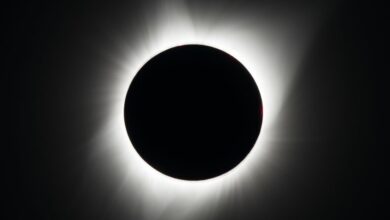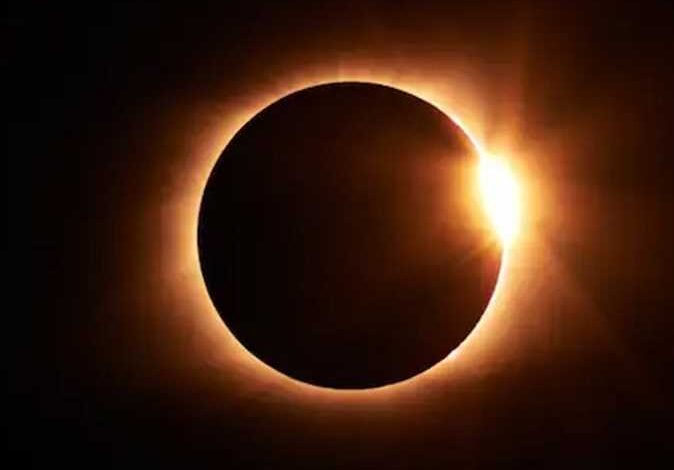
The world is preparing for a rare solar eclipse on August 12th. Day will turn to night temporarily as the sun’s disk disappears behind the moon in a breathtaking astronomical spectacle.
The eclipse will stretch across parts of the Northern Hemisphere and the Mediterranean, and astronomy enthusiasts are eagerly anticipating this event, making extensive preparations to observe it safely.
Darkness will descend on the Iberian Peninsula near sunset, as well as in small parts of Greenland and Iceland, where the sun, moon, and Earth will align perfectly in the sky, according to The Independent.
Longer eclipse next year
The total eclipse will begin near the North Pole before moving south and will last for up to two minutes and 18 seconds.
This marks the beginning of a longer solar display next year, a dazzling spectacle lasting six and a half minutes, which will extend from Spain to North Africa and the Middle East.
Darkness in the day
The moon’s shadow, or umbra, will take an hour and a half to travel 8,260 kilometers, mostly over the empty Atlantic Ocean.
The total eclipse will reach its peak off the west coast of Iceland.
By the time it reaches a small area of Portugal, then Spain, where large crowds are expected, the total eclipse will have diminished to a minute, ending in the Mediterranean Sea.
The partial eclipse will be visible in distant regions such as Alaska and Siberia, and will cover Canada, the northern US, much of Europe, and West Africa.
The closer one is to the path of totality, the more the sun will be obscured by the moon.
The sun will cover 94 percent of Dublin and 83 percent of Oslo, Norway. Montreal will see 18 percent of the sun disappear, while New York will experience nine percent, and Norfolk, Virginia, will see two percent.
Eclipse safety rules
According to NASA, eclipse glasses are essential, even if only a small portion of the sun is visible. You should view the eclipse through specialized glasses or a handheld solar projector.
You can view the eclipse directly without eclipse glasses or a solar projector only in one instance: when the moon completely obscures the sun’s disk during the brief period of totality.
Edited translation from Al-Masry Al-Youm