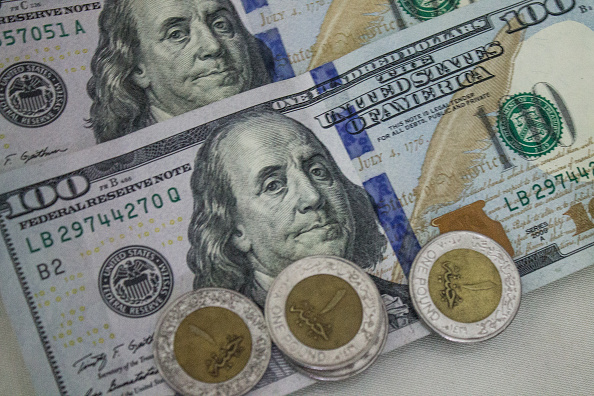
The year 2025 served as a practical test of how theoretical forecasts interact with the actual reality of the Egyptian foreign exchange market—not only in terms of the gap between the two but also regarding the fundamental shifts in the assumptions underpinning these forecasts over time.
Since the beginning of the year, the official exchange rate has moved within a relatively stable range.
Meanwhile, several estimates continued to project significantly higher levels, within the LE55 to LE60 per US dollar range by year-end, as reflected in Non-Deliverable Forwards (NDFs) and data from financial research centers.
This apparent discrepancy was rooted in a recurring historical pattern in the dollar’s time series, characterized by extended periods of stability and sideways movement, followed by sudden shocks driving prices toward higher levels in the form of compensatory jumps.
In these instances, the official rate often converges with the parallel market rate that emerges during periods of high demand and scarcity.
In the first quarter of the year, despite the stability of the official rate, estimates pointed to higher levels based on a historical reading of structural pressures and NDF figures, which priced the currency within the LE 55–60 range.
Institutional models and analytical forecasts, such as those from Fitch Solutions, projected rates between LE 50-55 by year-end, based on an analysis of import requirements, foreign exchange pressures, and external debt service obligations.
This phase clearly demonstrates that prolonged price stability, in the absence of genuine improvement in foreign exchange resources or the balance of payments, does not eliminate the upward trend but merely postpones it.
This aligns with exponential models used to capture general trends, which treat periods of dormancy as a temporary phase.
At the start of the second quarter, the forecasting landscape shifted due to a temporary improvement in cash flows—driven primarily by remittances from Egyptians abroad—alongside a seasonal drop in immediate demand for the dollar.
The use of liquidity management tools, such as currency swaps and forwards, also played a role. During this phase, analysts relied on actual liquidity data and short-term indicators, leading them to narrow their projections.
Scenarios shifted away from the likelihood of an imminent sharp spike, moving instead toward more moderate estimates that pushed the timeline for any significant price change further into the future.
By mid-year, the massive cash inflows from the Ras al-Hekma deal—signed a year prior—triggered another shift in expectations. This phase was driven by a direct monitoring of large dollar resources and their positive impact on foreign reserves.
This temporary abundance of cash calmed the market and led to the total disappearance of the parallel market.
Consequently, the focus shifted toward how long these inflows could sustain stability, rather than predicting when the next price jump might occur, especially as the government announced similar upcoming deals, such as the Alam al-Roum project.
As the year drew to a close, the official exchange rate remained within a narrow range, supported by international reserves rising above $50 billion for the first time in years.
This stability was further bolstered by a drop in annual inflation and a modest improvement in foreign investment.
Short-term market forecasts at this stage were based on Central Bank data and real-time financial indicators, all of which showed a tangible five percent to seven percent increase in the pound’s value against the dollar over the year.
However, major international financial institutions, led by the International Monetary Fund, maintained a more cautious long-term outlook, projecting a balanced rate between LE51 and LE54 per dollar.
This highlights the gap between the short-term view—driven by improved cash flow—and the medium-to-long-term view, which suggests that current stability may remain fragile. These institutions believe the rate could face further adjustments unless temporary support is replaced by permanent, structural improvements in the balance of payments.
This highlights the difference between viewing the events of 2025 as an isolated incident or as part of a long-term trend. The long-term exchange rate does not change significantly over a few months, as it reflects accumulated structural imbalances.
However, the timing of when we reach that rate is influenced by temporary factors, such as unusual cash inflows, brief improvements in liquidity, or seasonal drops in demand.
The answer to whether temporary stability can become permanent lies in deep reforms to the ‘real economy,’ rather than in the exchange market or monetary decisions alone.
This reform is built on three main pillars: restructuring the national production base to be more diverse and internationally competitive—thereby reducing reliance on imports and boosting non-traditional exports; deeply diversifying foreign currency sources by attracting long-term direct foreign investment and building a strong export base; and addressing the underlying demand for the dollar caused by economic gaps, such as energy shortages, import dependency, and capital flight.
In short, 2025 was a practical chapter that demonstrated how temporary cash inflows and clever monetary policies can calm pressures and delay price spikes.
However, achieving lasting stability depends on a comprehensive overhaul of the real economy.
Given the Central Bank’s unstated exchange rate policy, which revolves around a ‘flexible peg’ philosophy, establishing an official index to define the dollar’s price range has become vital. Such an index would provide a clear framework for the market, limit temporary fluctuations, and increase transparency for future expectations.
Without this index and deep-rooted reform, any stability will remain fragile, and the historical pattern of ‘corrective jumps’ will remain the deciding factor in the currency’s long-term path.
Author’s biography:
Medhat Nafei is an experienced economist and business leader.
He served as Deputy Minister of Supply and Internal Trade in Egypt and is currently the Chairman of Arab Alloys, and holds a PhD in Economics from Cairo University.