In much of Africa, limited and unreliable grid coverage means many depend on diesel generators to power their homes and businesses. In Sub-Saharan Africa alone, there are an estimated seven million back-up diesel generators, consuming more than $20 billion in diesel per year.
As well as releasing carbon dioxide, which contributes to global warming, diesel generators emit tiny particles that reduce air quality and can cause respiratory problems and increase risk of cardiovascular disease, and even cancer.
South African energy startup Hyena is trying to reduce the continent’s reliance on diesel generators.
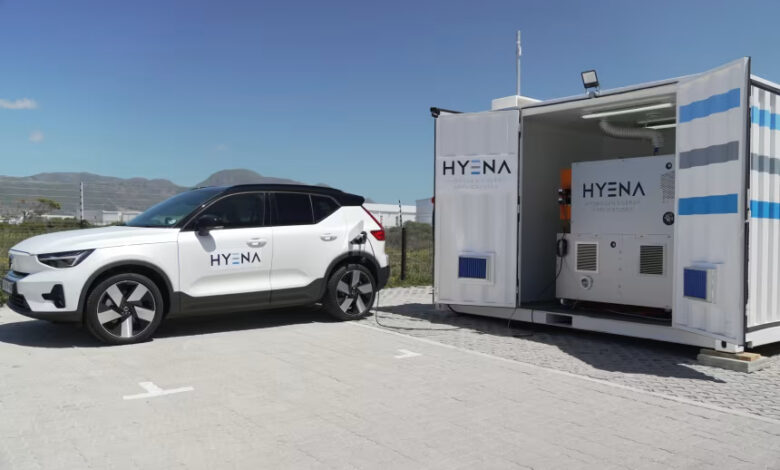
Its POWER PODs are around 1.5 meters long, 1 meter wide and 1.8 meters tall and are intended to be used at locations that are off grid or have an unreliable energy supply. They convert liquid petroleum gas (LPG) into hydrogen, and then into electricity, producing heat and water as by-products.
The POWER PODs produce no harmful particulates, and release 15% less carbon dioxide than diesel generators, according to Hyena co-founder Jack Fletcher.
Fuel cells that generate electricity from hydrogen are not a new technology, but they have seen limited adoption in Africa due to a lack of infrastructure for hydrogen production, storage and distribution. Hyena’s innovation is to develop one that also produces hydrogen from LPG — a mix of gases including propane and butane.
“Liquid petroleum gas is the same gas you would buy locally to cook on or to heat your house,” Fletcher tells CNN.
“It’s available throughout Africa and it can be stored easily. The regulations for its use are already in place (and) people are familiar with using it, so there’s no extra barrier to its use.”

Fletcher says that by producing hydrogen from LPG at the point of use, the POWER POD could enable the widescale deployment of fuel cell technology across the continent, even in remote locations.
He sees one of its primary uses as powering telecommunications towers, which require an almost constant energy source. Due to frequent grid outages and lack of connectivity, three quarters of Africa telecom towers are powered by “grid/diesel hybrid systems,” according to market research firm Mordor Intelligence.
The first proof-of-concept deployment of a POWER POD on a live tower is expected in early 2026.
‘A pragmatic solution’
As well as being cleaner, fuel cells are also quieter than diesel generators and require less maintenance, says Sakib Khan, a South Africa-based energy consultant specializing in the African hydrogen economy, who is not associated with Hyena.
While the POWER PODs still emit carbon dioxide, Khan thinks hybrid technologies like Hyena’s, which use existing fuel infrastructure, will be essential for de-carbonizing Africa.
“The solution that Hyena has come up with is a pragmatic solution, it’s a bridge,” he says, adding that Africa must consider social and political considerations when implementing green energy technologies.
“Our net-zero path will look different to, say, Europe’s. It will be more decentralized,” he adds. “In Europe … pretty much everyone has power, (so) you can focus on emissions.
“We also have to look at energy access and balance that with emissions as well.”

Global hydrogen production reached almost 100 million metric tons in 2024 but less than 1% was derived from low-emissions hydrogen technologies, according to the International Energy Agency.
The Africa Green Hydrogen Alliance, which aims to foster collaboration between hydrogen-producing African nations, highlights that the continent has vast solar and wind resources, and that these make it well-placed to become an important producer of green hydrogen — hydrogen made from water using renewably generated electricity.
“When green hydrogen is available, this can be fed directly into the fuel cell, leading to zero-carbon emissions,” says Fletcher, who hopes the POWER POD will be a step towards a large-scale transition in Africa to carbon-free energy.
While the South African government has laid out several initiatives to support the country’s hydrogen economy, Fletcher says that “there are not a lot of investors in hydrogen in Africa.”
He says Hyena has raised approximately $2 million — including from the University of Cape Town, where the company began as a research unit — but needs more.
“The biggest challenge we’ve had so far is raising the necessary amount of funding. The technology is not cheap, especially as a startup. We are only producing a few units at a time,” he adds.
The technology could be available for domestic use “in the longer term,” adds Fletcher, if the company can increase its production capacity and bring down manufacturing costs.
Khan says price could be a barrier to the adoption of POWER PODs, as could training people to use them, adding that “there is a cost associated with upskilling people.”
Nevertheless, Fletcher has high hopes for the POWER POD. “I think we’re probably about a year or two away from really putting our technology out there,” he says.
“We now have a system… we can deploy anywhere in the world using available fuel infrastructure, so that now makes fuel cells a real possibility.”
Jo Munnik contributed to this report.