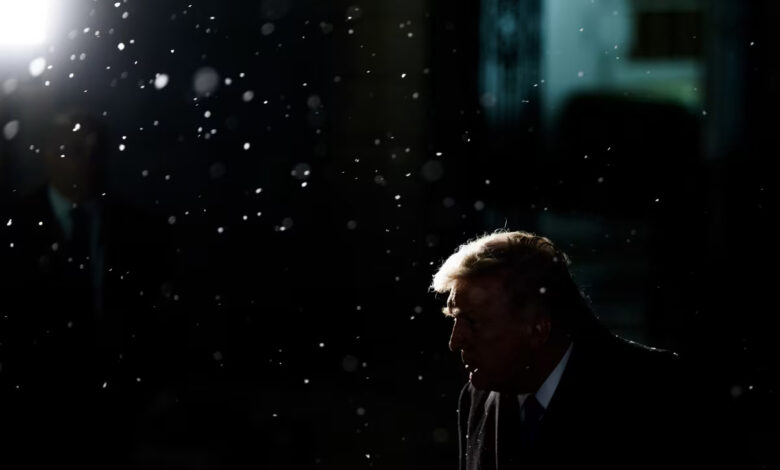
The most volatile president in living memory is becoming ever more driven by the whiplash of his personal whims.
The disciplined execution of the early months of President Donald Trump’s second term — when well-drafted executive orders reshaped Washington and America’s global priorities — are now a memory.
Shuttering USAID, gutting the federal government, and assaulting the Ivy League curriculum might have been controversial. But they sprang from a rational playbook drawn up during Trump’s four-year exile from the White House.
But lately Trump seems to be winging it more than usual. And he’s getting more extreme. His brittle temper in Washington — a contrast to his sunnier mood at weekends at home in Florida — is increasingly threatening.
How far he goes in his quest for dominance may depend on the tension between his strongman outbursts and domestic and international political realities that occasionally rein him in.
A wild week in a volatile year
Just last week, Trump sparked outrage with the most racist messaging anyone can remember from a White House when a reposted cartoon video on his Truth Social account depicted Barack and Michelle Obama as apes.
Trump recently took fresh aim at elections, with America’s top intelligence official Tulsi Gabbard traveling to Georgia to search for evidence to prove his false obsession about fraud in 2020. He raised new concerns last week that he’ll try to fix November’s midterms by demanding the nationalization of voting.


At the same time, confusion mounted over the status of his migrant crackdown, after two US citizens were shot by federal agents sent to Minnesota. Trump’s now calling for a “softer touch.” But this may only be a rebrand to ease disastrous optics of a purge that alienated many voters. And the federal agents sent into city streets in khakis were the direct result of Trump’s relentless personal demands for the militarization of law enforcement.
Meanwhile, Trump’s fixation with his legacy and his manic efforts to plaster his name everywhere took another twist last week, when it was reported he wanted Dulles International Airport and New York City’s Penn Station renamed after him.
On Sunday, he went on another Truth Social tirade, slamming the Super Bowl half time show by Puerto Rican star Bad Bunny as an “Affront to the Greatness of America,” saying that “Nobody understands a word this guy is saying, and the dancing is disgusting, especially for young children.”
Earlier, the president had lashed out at US Olympic skier Hunter Hess who had said that just because he was “wearing the flag doesn’t mean I represent everything that’s going on in the US.” Trump wrote, “If that’s the case, he shouldn’t have tried out for the Team, and it’s too bad he’s on it.”
Now and again, Trump acts in a conventional, strategic manner — for instance with his unveiling last week of a TrumpRx website designed to lower drugs prices — although the plan is far more restrictive than he often claims.
But the impression of a president concentrating on his own, often erratic goals while being indifferent to the plight of ordinary voters is growing. He told NBC News in a Super Bowl interview aired Sunday, for example, that he was “very proud” of the economy, making a misleading case that he’d lowered grocery prices across the board. While the stock market has been in robust health — the Dow Jones Industrial Average closed above 50,000 last week for the first time — the Trump economy has yet to deliver its benefits to all income levels.
The political cost of this impulsive self-obsession is becoming clear. In a CNN poll last month, only 36% of Americans said the president had the right priorities, down from 45% near the beginning of his term. Only one-third of Americans said they believed that Trump cares about people like them, down from 40% last March and the worst rating of his political career.
Greenland shows how wild rhetoric becomes policy
Some administration policies have shown some level of planning and delivery — like the raid that toppled President Nicholas Maduro in Venezuela. But chaos and unpredictability reminiscent of Trump’s leadership during the Covid-19 pandemic in his first term are mounting.
One repeating pattern this year has been when the president lashes out with a wild comment or accusation. Officials rush to justify and act on his impulse.

This was the case when Trump’s demands for Denmark to cede Greenland in January nearly broke NATO. It also manifests in Trump’s incessant tinkering with tariffs.
The Greenland eruption, however, also showed that even Trump sometimes comes up against international or domestic realities. European resistance and Republican anger over his Greenland gambit triggered a climbdown after a trip to Davos, Switzerland.
At other times, the diminished political standing of his presidency forces a recalculation, as happened when Republican anger led to him taking down the racist video from his Truth Social site.
This push and pull between Trump’s desire to wield ever more unaccountable power and remaining political and constitutional restraints on his actions is coming to define the politics of midterm election year.
The election will show whether voters nationwide want to rein Trump in or grant him continued expansive leeway. And whether he will accept their democratic verdict.
ICE showdown looms
No one knows what Trump will do next. And perhaps he doesn’t either. But one showdown that the country can bank on this week is over ICE.
Democrats hope to use a funding fight over the Department of Homeland Security budget that threatens to cause a government shutdown by the end of the week to impose limits on ICE agents after the killing of Renee Good and Alex Pretti.


“We know that ICE is completely and totally out of control,” Democratic House Minority Leader Hakeem Jeffries told CNN’s Dana Bash on “State of the Union” on Sunday. “They have gone way too far, and the American people want them reined in, because immigration enforcement should be fair, it should be just, and it should be humane.”
But Republicans are pushing back, notwithstanding Trump’s call for a softer approach and the issuing of body cameras to ICE officers in Minnesota last week.
The clash will again test whether Democrats can use growing public disquiet with Trump to impose meaningful constraints on his policies despite being locked out of power on Capitol Hill and in the White House.
Last week, the administration said it would pull back 700 ICE agents from Minneapolis. This, like Trump’s call for a “softer touch” generated helpful headlines after the public turned on his enforcement methods.
“The reason we’re pulling out because we’ve done a great job there,” Trump told NBC News in his Super Bowl interview.
‘It was a disgusting video’
Trump’s refusal to apologize for the racist video that was posted on his Truth Social site underscores how his history of outlandish conduct has insulated him against the consequences of his actions. A CEO who posted such material could expect to lose their job. But the White House initially blamed the backlash not on the offensive content but on those who were offended.

But Republican anger over the post, including condemnation from the only Black GOP senator Tim Scott quickly eroded the political foundation of that position. The content was deleted and a staffer was blamed for posting it. Trump insisted he’d not seen the part that was offensive. But he refused to apologize, saying that he’d done nothing wrong.
His recalcitrance set off a new wave of criticism on Sunday.
“He definitively needs to apologize. It was a disgusting video,” Jeffries said on “State of the Union.” “The president was rightly and appropriately and forcefully denounced by people all across the country, Democrats, and even a handful of Republicans, who finally showed some backbone in pushing back against the president’s malignant, bottom-feeder-like behavior.”
New York Republican Rep. Mike Lawler, who is running for reelection in one of the most competitive districts in the midterms, also condemned the post. “I think sometimes it’s just best to say ‘I’m sorry’ and do better,” Lawler told ABC, adding that such content shouldn’t exist in America.
If the post was an outlier, it would be one thing.
But there’s growing evidence that such extremism is a dominant feature of Trump’s second term.