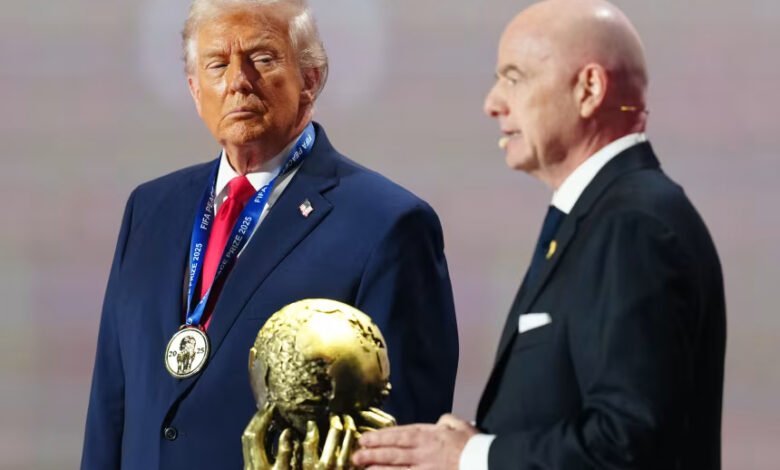
Before the 48 teams were drawn into groups for the 2026 FIFA World Cup, US President Donald Trump was invited onto the stage to receive a trophy.
“This is your peace prize,” said FIFA President Gianni Infantino. “There is also a beautiful medal for you that you can wear wherever you want to go.”
As Trump reached for the ribbon and poked his head through its loop, FIFA’s words of praise were still ringing in his ears.
“We honor a dynamic leader who has engaged in diplomatic efforts that created opportunities for dialogue and de-escalation and stability,” said the narrator of a four-minute video celebrating the first recipient of FIFA’s brand-new honor.

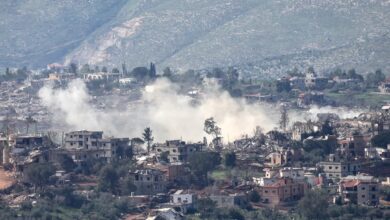
Less than three months later, Trump spoke with CNN’s Jake Tapper to boast about his latest foreign policy initiative in the Middle East: A war with Iran.
“We’re knocking the crap out of them,” Trump said of the airstrikes he had unleashed alongside the Israeli government. “We’ve got the greatest military in the world and we’re using it.”
In between receiving FIFA’s Peace Prize and unleashing Operation Epic Fury in the Middle East, Trump authorized military action against ISIS-affiliated forces in Nigeria on Christmas Day and his government executed a military incursion into Venezuela, capturing President Nicolás Maduro. He put NATO allies on edge with a threatened takeover of Greenland that was resolved at intense meetings at the World Economic Forum and went back to his trolling of Canada by calling Prime Minister Mark Carney “governor,” a callback to his wishes to make the US’ northern neighbor the 51st state.
But the action against Iran has trumped it all and put FIFA’s honor under a harsh spotlight. Soccer’s world governing body is proud of saying its game can unite the globe and bring about peace, but if the situation in the Middle East spins further out of control, the World Cup risks being eclipsed by a war started by the man FIFA just awarded its Peace Prize.
When asked for comment, a FIFA spokesman pointed to Infantino’s defense of awarding the peace prize to Trump in an interview to Sky News last month.
“If you managed to save lives, to protect your people and other people around the world, you deserve respect,” Infantino said in the interview. “He was instrumental in resolving conflicts and saving lives and saving thousands of lives.”
A tournament amid global conflict
When festivities kick off in the US, Canada and Mexico this summer, it will likely be complicated by hostilities near and far.
Just a few days before the US teamed up with the Israeli military to pound targets in more than a dozen Iranian cities from Tabriz to Chabahar – killing Iran’s Supreme leader Ayatollah Khamenei in the process – the Mexican government launched a daring assault on the infamous Jalisco New Generation cartel.


Drug lord Nemesio Rubén Osegeura Cervantes, also known as “El Mencho,” was killed just a couple of hours away from Guadalajara, one of 16 World Cup host cities. Trump had long been pressuring his Mexican counterpart, President Claudia Sheinbaum, to crack down on the cartels, but the impact of El Mencho’s death could now destabilize one of the World Cup host nations at a time when thousands of football fans are planning to visit.
Infantino quickly declared his “complete confidence” in the Mexican authorities’ ability to successfully stage their World Cup matches, but he couldn’t deny the spontaneous carnage which had left at least 70 people dead.
“Mexico is a great country, like in every other country in the world, things happen; we don’t live on the moon or another planet,” he said. “That’s why we have governments, police, and authorities who will ensure order and security. We are convinced that everything will go as smoothly as possible.”
Mexico City will host the tournament’s opening fixture between Mexico and South Africa on June 11, but the country’s other host cities – Guadalajara and Monterrey – will also host the Intercontinental Playoffs later this month. Despite Infantino’s assurances, speculation arose that perhaps those matches, coming so soon after the outbreak of such indiscriminate violence, could be played somewhere safer. Lusail in Qatar, which staged the last World Cup final between Argentina and France, was discussed as an option.
However, Qatar was almost immediately drawn into the conflict in the Middle East, as Iran dispatched a volley of ballistic missiles and drones across the Strait of Hormuz. In the early throes of the war, the Qatari military said that it had downed two Iranian SU-24 supersonic strike aircraft.
Qatar, Saudi Arabia, and possibly Iraq will play in the World Cup this summer; Iran has launched missiles at all three countries in recent days. The Iranian football team was the first to qualify from the Asian region, and has made plans to travel to Tucson, Arizona, using the Kino Sports Complex as a base camp. “Team Melli,” as they are known, must now wrestle with uncomfortable prospect of being hosted by a country with which its government is at war.

That is, if they play at all. Mehdi Taj, president of Iran’s Soccer Federation, says that their participation is now in doubt.
“What is certain is that after this attack, we cannot be expected to look forward to the World Cup with hope,” he told sports portal Varzesh3.
Not since the 1950 tournament in Brazil has any team withdrawn from the competition after qualifying.
Tensions between US and Iran test Infantino
Whatever Iran decides to do this summer, their participation in the tournament was already affected by the tensions with the US.
As a result of the US State Department’s recently imposed travel restrictions, Iran’s fans had been told that they would be denied visas to enter the country. Last December, the Iranian delegation almost boycotted the draw in Washington, DC, because they were only granted four visas out of the nine that they applied for; Federation President Mehdi Taj was denied a travel permit.

Fans from Haiti, Ivory Coast and Senegal, the two most recent African champions, will also be denied entry visas. In 2017, the year before FIFA awarded the United States joint hosting rights for the tournament, Infantino told reporters, “It’s obvious when it comes to FIFA competitions, any team, including the supporters and officials of the team, who qualify for a World Cup need to have access to the country, otherwise there is no World Cup.”
Infantino seems to have different concerns now, given that he is on the brink of overseeing the most lucrative tournament in the 122-year history of his organization. (According to analysis conducted by Sports Value, this World Cup will generate untaxed revenues of $10.9 billion for FIFA, an increase of 56% on the last tournament in Qatar.)
Meanwhile, Infantino has become much more than just a senior sports administrator through his close association with Trump, popping up regularly as the US president hosts White House events or attends high-profile sporting events.

He now presents himself as a global statesman. Infantino has been pictured in Mar a Lago and the Oval Office numerous times, he attended Trump’s second-term inauguration, and he accompanied the president to the “Summit for Peace” in Egypt where the future of Gaza and Israel’s war with Hamas was discussed. A photo of Infantino shown during that slow-motion video at the World Cup draw, giving an enthusiastic thumbs-up gesture, was described by The Guardian as like “a proud football dad.”
FIFA’s own code of ethics states that the organization should be politically neutral, but Infantino appears to be rather comfortable in the presence of one of the world’s most divisive leaders. In February, he attended Trump’s Board of Peace meeting, donning a red MAGA-style hat with the numbers denoting Trump’s presidencies, 45 and 47, stitched onto the side.
Typically, the FIFA president would be the most powerful man on the sidelines of a World Cup, but this will be a tournament unlike any other, as Trump will undoubtedly be hovering around the festivities. The US president has enjoyed displaying the iconic World Cup trophy in his office at The White House – “what a beautiful piece of gold,” he once remarked – and he has demonstrated his willingness to use athletes and sports teams to further his political agenda.
Last summer, during FIFA’s inaugural Club World Cup tournament, Trump hosted the Juventus team and, with the cameras rolling, he rhetorically asked the players if they thought a woman could be good enough to play on their team. The participation of transgender women in sports was a major talking point in the 2024 election and a focus for Trump in 2025 when Juve visited the White House, though it has been less discussed in recent months.

At the final in New Jersey, he presented the trophy to the Chelsea team, whose bewildered players then had to celebrate their victory alongside him because he chose not to exit the stage, and at the Ryder Cup in September, he made a great show of swooping in low over the Bethpage Black golf course in Air Force One.
Whatever happens on the field, this is guaranteed to be a highly politicized World Cup. The tournament has been designated as a centerpiece of the United States’ 250th anniversary celebrations, with plans including “freedom trucks” at Fan Fests to promote “the very best of America to the world,” according to The Athletic. While the fan fests are run by the host committees of each city, it is undoubtedly a statement of what the host nation hopes to get out of having the world’s soccer fans travel to its shores.
It all comes together to force the tournament’s governing body to face a difficult question: Is it unwilling or simply unable to prevent its tournament being hijacked by the world’s most prominent leader and overshadowed by the world events that he has ignited?