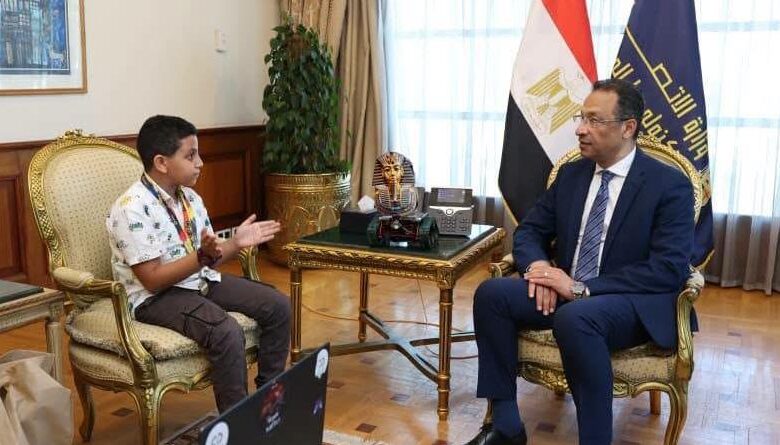
Minister of Communications and Information Technology Raafat Hendy honored 10-year-old Martiros Mina for winning awards and securing top rankings in local and international programming and robotics competitions.
Martiros, a fourth-grade primary school pupil, won a gold medal in an international Python programming competition organized by China this year and ranked among the top two percent of participants worldwide, according to the ministry.
“Promising technology talent is a national asset,” Hendy said, stressing that the ministry seeks to help young people turn their passion for technology into “innovations and solutions capable of competing globally.”
The minister said the ministry was committed to providing talented children and young people with a supportive environment in which to develop their digital capabilities, refine their skills and participate in international competitions.
Such efforts aim to prepare “a generation of innovators capable of competing globally in advanced technology fields,” he added.
During the meeting, Martiros recounted how his interest in programming and robotics began at an early age. He designed and built his first robot at five and began studying programming at a specialized academy the following year.
At seven, he participated in his first local competitions. From the age of eight, he began competing internationally in China, Estonia, and Romania, winning several awards and top rankings.
Martiros also presented one of his most notable inventions to the minister: a robot tour guide designed in the likeness of King Tutankhamun to introduce visitors to Egyptian antiquities at the Egyptian Museum.
Hendy directed the ministry to allow Martiros to join the Robotics and Embedded Systems track under the Digital Egypt Clubs initiative, despite being below the program’s minimum enrollment age.
Martiros will undergo an assessment of his programming and technological skills to determine the training level best suited to his abilities.
The minister also presented him a laptop and several robotics kits to encourage him to continue learning and turn his ideas into projects and solutions with the potential for further development.
Hendy highlighted the ministry’s efforts to develop children’s technological skills from an early age through programs including the Digital Egypt Buds and Digital Egypt Cubs initiatives, which provide specialized training tracks tailored to different age groups.
The ceremony was attended by Hoda Baraka, adviser to the communications minister for technological skills development, and Martiros’s parents.
The decision to admit Martiros is exceptional because the Digital Egypt Cubs Initiative normally accepts students aged 12–17, from the first preparatory grade to the second secondary grade.
As a fourth-grade pupil, Martiros falls within the age group normally served by the Digital Egypt Marvels Initiative, which targets pupils in grades four to six.
He is therefore being admitted several years before the Cubs program’s standard entry point. The Cubs initiative offers advanced tracks including robotics and embedded systems, web development, artificial intelligence and data science, cybersecurity, and digital arts.
The Cubs program was launched in the 2022/2023 academic year.
It began with a $25 million budget and partnerships with 10 international technology companies, including Google, Microsoft, IBM, Cisco, Huawei, Dell Technologies, and Vodafone.
It was initially designed to train 3,000 high-performing school students annually over five years through online and in-person instruction.
The ministry said in May 2026 that its Marvels and Cubs initiatives had trained approximately 240,000 pupils nationwide since their launch. In 2025 alone, around 70,000 primary-school pupils trained under the Marvels program, and another 62,000 preparatory- and secondary-school students participated in the Cubs program.