Hungary and Ukraine are again trading accusations after two backpacks containing explosives were allegedly found by a gas pipeline near the Hungarian border, days before the country’s election.
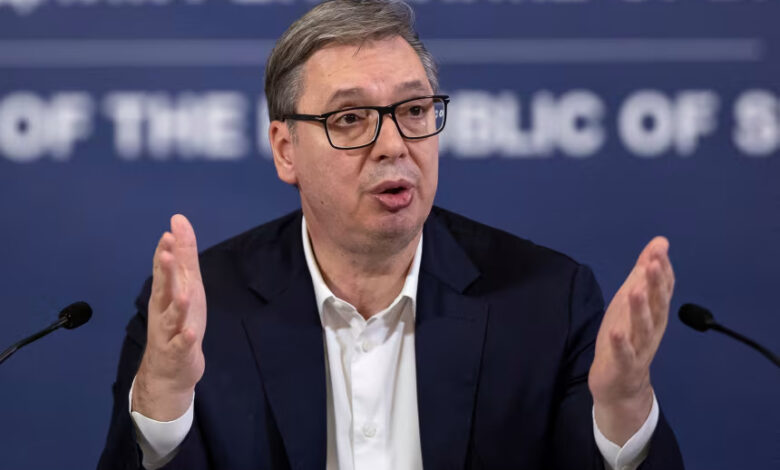
The devices were found in northern Serbia on Sunday, according to Serbian President Aleksandar Vučić, close to the pipeline that carries Russian gas to Hungary.
In posts on social media, Hungarian officials sought to link Ukraine to the incident.
“Just a series of coincidences,” wrote Balázs Orbán, a senior official in Prime Minister Viktor Orbán’s office, before listing the pipeline incident, the closure of another oil pipeline bringing Russian oil to Hungary and the attack on the Nord Stream pipeline in 2022.
“Ukraine wants to force Hungary to abandon its pro-peace position and support the war,” he added.
Orbán is in the midst of a bitter election campaign to extend his 16 years in power, with opinion polls showing his Fidesz party trailing the opposition Tisza party ahead of the April 12 vote. The Hungarian leader has sought to associate the opposition with Brussels and Ukraine, suggesting that voting for Tisza means voting for war.
The Ukrainian Foreign Ministry said Sunday it categorically rejected “attempts to falsely link Ukraine” to the latest incident.
“Ukraine has nothing to do with this. Most probably, a Russian false-flag operation as part of Moscow’s heavy interference in Hungarian elections,” spokesman Herhii Tykhyi said on X.
Tisza leader Peter Magyar suggested Sunday’s incident was a ruse aimed at improving Orban’s electoral prospects.
“Several people have publicly indicated that something will ‘accidentally’ happen at the gas pipeline in Serbia at Easter, a week before the Hungarian elections. And so it happened,” Magyar said in a statement.
Blaming Ukraine
Foreign Minister Peter Szijjártó compared the discovery of the backpacks to the the attack on the Nord Stream pipeline, which he has blamed on Ukraine.
Kyiv has repeatedly denied any involvement in that attack, in which a series of underwater explosions triggered major leaks from the natural gas pipelines linking Russia and Germany via the Baltic Sea.
Both Serbia and Hungary are still heavily reliant on Russian energy supplies, putting them odds with other European countries seeking to reduce their reliance on Russian supplies.
The backpacks, containing “two large packages of explosives with detonators,” were found in Kanjiza, in northern Serbia, “a few hundred meters from the gas pipeline,” said Serbia’s Vučić, a close political ally of Orbán.
Video and images in Serbian media showed an extensive police presence in the area, along with roadblocks and helicopters above.
Vučić said he had informed Orbán “of the initial results of the investigation by our military and police authorities into the threat to the critical gas infrastructure.”
He added that the explosives could have “endangered many lives” and caused significant damage to the pipeline.
Close ties
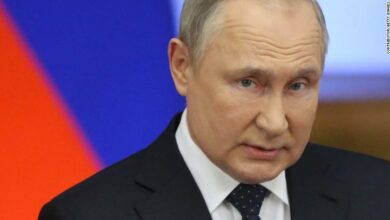
Vučić and Orbán both have strong relations with Moscow. Last month, Serbia secured a further three months of gas imports from Russia following talks between Vucic and Russian leader Vladimir Putin.
Orbán has frequently complained that Ukraine has blocked its oil supplies through a Russian pipeline that crosses Ukrainian territory.
On Saturday, the Hungarian prime minister posted a video warning that a “severe energy crisis is approaching, accelerating day by day,” because of the war in the Middle East, and demanded that the European Union suspend sanctions on the import of Russian energy.
Hungary has used its own exemption from the EU sanctions to deepen its dependence on Russian fossil fuels.

The accusations flying back and forth come amid Orbán’s longstanding disagreements with the European Union over relations with Russia, support for Ukraine and immigration.
He has also been an outspoken ally of US President Donald Trump and received vocal support from Trump administration officials.
In the last week of Hungary’s election campaign, US Vice President JD Vance will visit Budapest to meet Orbán. In February, US Secretary of State Marco Rubio said relations between Washington and Budapest had entered a “golden age” and told Orban at a news conference that “your success is our success.”
Orbán faces an uphill battle to remain in office, according to analysts.
Two polls published last week showed the center-right Tisza party widening its lead over Fidesz, although a large share of voters remained undecided.