Jesús Armas sips coffee with his partner in a sidewalk café. María Pérez takes part in a public protest. Melva Vásquez holds up enlarged photos of her son and her daughter outside a prison where political opponents are held.
These seemingly ordinary actions were all but unthinkable just a few months ago under the rule of Nicolás Maduro in Venezuela.
The United States has done its best to give Venezuela a shiny new image this year — from the daring and deadly night raid to capture Maduro, beefing up diplomatic relations and sending Cabinet secretaries for all-smiles visits with the acting president, and allowing the resumption of direct flights. But Armas, Pérez, Vásquez and many other Venezuelans are waiting to see whether change will take hold or whether the still-visible security apparatus will again spur the Latin American nation towards repression.

“We need elections,” said the demonstrator, Pérez. “We don’t have freedom. Flexibility, but not freedom.”
In the capital Caracas earlier this month, CNN found a palpable edginess about the future from Venezuelans regardless of political leaning. They have witnessed Maduro’s arrest and detention in New York and have seen the US buoy the rest of his government. Glitzy high-profile events promise the return of massive foreign investments. But the deprivation that spurred millions of Venezuelans to leave their country in the last decade — many coming to the US — is still obvious in the empty refrigerators and bare pantry shelves in many homes.
Venezuela’s new leader, Delcy Rodríguez, says she sees a “rebirth” for her country. But many of the people CNN spoke with said the US will decide whether their country succeeds or fails.
Everything demands a second look
At Simón Bolivar International Airport, border officers seemed confused by an influx of American journalists until realizing they had just landed from “that flight” on April 30.
Hours earlier, Miami International Airport’s Gate D55 had been wrapped in a festive atmosphere — decorated with balloons in the yellow, blue, and red colors of the Venezuelan flag.


Travelers were offered cafecitos and the Venezuelan pastry treat of arepas to mark the first direct flight from the US in nearly 7 years. Venezuela’s top diplomat to the US, Félix Plasencia, was along for the trip, as well as officials from the State Department, American Airlines representatives and folks who booked the flight to visit loved ones.
It was the latest big media moment encouraged by the US. Along with the resumption of flights came visa approvals that had been pending for months. But the plane itself held fewer than 100 passengers. And so far, there’s only a few flights a day — albeit with hopes and promises for more.
Like so much here, everything in Caracas — a sprawling metro area of almost 3 million people nestled in a valley surrounded by mountains —demands a second look.
The drive from the airport headed inland along smooth roads through tunnels and over mountain ridges. Reaching the city, we saw the occasional armed riot police in protective suits holding shields.
Many of the people out and about were merely standing in line — waiting hours for buses as the only affordable transportation to get them home or to a second job. There was much to buy from fresh fruits to Ferraris, and plenty of American brands like Coca-Cola and Doritos, but few were shopping because they struggle to afford the basics.
When President Donald Trump announced the detention of Maduro, he said: “The dictator and terrorist Maduro is finally gone in Venezuela. People are free, they’re free again. It’s been a long time for them, but they’re free.”
For the people we met, that’s still a promise and a hope, rather than a reality.
Political activist Sairam Rivas feels safe enough to wear a t-shirt demanding “Free all political prisoners” in public. But she and her partner Jesús Armas still feel the eyes of the state around them.

Armas, the 2024 election campaign manager in Caracas for opposition leader María Corina Machado, was one of those political detainees until Maduro’s arrest and a new amnesty.
He and Rivas had moved from safe house to safe house since Maduro was proclaimed the winner in defiance of all evidence the day after the July 2024 general election. After five months of this, Armas was a little stir crazy and decided to take his laptop to work in a coffee shop in December 2024. As he left to head home, he said eight masked men dressed in black abducted him and he was held until February of this year, lastly in the El Helicoide prison used by the intelligence services in Caracas.
Armas said he heard explosions connected to the January 3 US raid that spirited Maduro away but discounted a cellmate’s assertions that the “gringos” had come until a prison officer shared the news the following morning.
“Actually, he was really happy,” Armas said of the officer who told the prisoners of the raid. “And almost all the guards inside El Helicoide were really happy.”
But government, military and civilian leadership has remained largely the same as under Maduro.
“There’s still repression going, but less,” said Rivas. Armas added he was followed by officers from the intelligence services so frequently he now recognizes them, although he does not believe he is in immediate danger of being detained.
Officials declined to comment specifically on Armas’s case but have said accusations of human rights violations were false. When she signed the amnesty law that she proposed under pressure from the US, acting President Rodríguez described the moment as “an extraordinary door for Venezuela to reunite, for Venezuela to learn to coexist democratically and peacefully, for Venezuela to rid itself of hatred, of intolerance, let it open up to human rights.”
The more things change…
The relaxing of the rules, yet the pain of the crackdown, is embodied by Melva Vásquez. The white-haired mother now lives in a tent outside the El Rodeo prison, about 35 miles east of Caracas, as she campaigns for her son Merwyn Simons and daughter Anyela Bermúdez, both held by the regime. She cannot afford to travel back and forth from her home eight hours away.
The display of opposition, complete with enlarged photos of her adult children, would not have been allowed under Maduro’s rule. The Venezuelan government alleges the siblings were part of a plot to bomb a public square in the capital. But their mother said they are not involved in politics, and she did not understand why they were in prison.
“We’re living in agony,” she said of herself and other mothers camped outside El Rodeo. “You see us calm because what else do we have? We can’t despair, because in despair we lose everything.”

Caracas resident and local journalist Carolina Alcalde said Venezuela these days feels “fragile.”
“The economic situation is very difficult, the incomes are very, very low, and everything is so expensive, I think that that’s the major focus of the people. People are still afraid to say things, especially when it’s about politics, because you never know how the government or the people in power are going to react.”
Beyond local politics, Alcalde said Venezuelans are also looking to the US midterms in November. While foreign policy won’t be top of many US voters’ priorities, Venezuelans wonder what the knock-on effects of a congressional reset could be and how the Trump administration would react.
On the streets of Caracas, graffiti and murals make the claim that the key political prisoners are the ones held in Brooklyn, New York. “Free Nicolás! Free Cilia!” they demand for the ousted president and his wife.
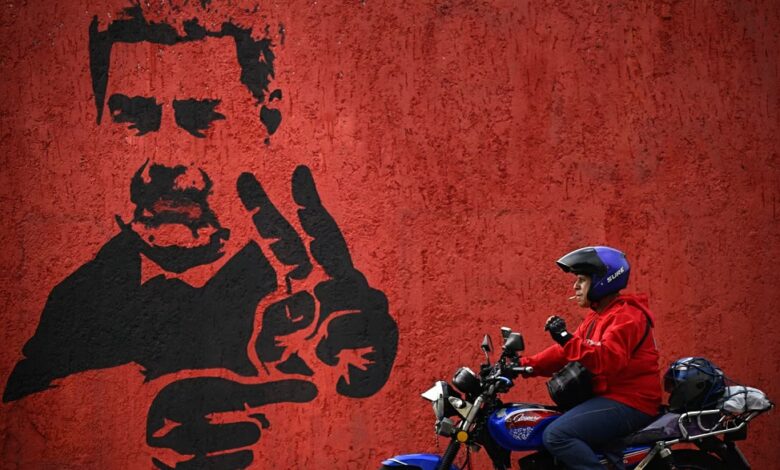
Other public art still shows Maduro as the successor to Hugo Chávez as leader of the socialist revolution in Venezuela, who was then succeeded by his own deputy, Delcy Rodríguez.

At an opposition rally in Caracas on May Day, the global workers’ celebration, there were demands for a return to democracy, along with chants for better wages and pensions.
Aida Guevara, wearing a baseball jersey emblazoned with “America” across the front along with Venezuela flag glasses, said her country had gone backwards under socialism.
“I have a pension that isn’t enough to buy my medicine. I can’t buy it or keep it regularly in my home,” Guevara said. She said she hadn’t wanted the US intervention, but was grateful for Trump’s decision.
“I’m not happy about what happened, but I am happy because I can speak with you calmly, safely, with peace.”
A competing pro-government march was organized in Caracas on the same day, with drums, dancers and signs reading “Venezuela no es una colonia.” Venezuela is not a colony.
An organizer said Trump was “loco,” crazy, “Because of the measures he takes — he says one thing today, tomorrow he says another.”
He also pointed to immigration issues in the US, including the treatment of Venezuelan migrants, and questioned why the people taking those actions should be trusted to help Venezuelans in their own country.
Support for the remains of Maduro’s government exists, though it’s more often seen on the walls than heard.

After the opposition demonstration, Pérez, a seamstress, showed us her home and those of her close family members, on the steep hills overlooking the capital. On this day there was electricity, so her diabetic father, Secundino Delgado, could watch action shows on television in bed. That also meant the refrigerator had power though it contained only a few tomatoes, a bell pepper, a half bottle of soda and what looked like ribs on a plate, certainly more bone than meat.
The fridge underscores two of the critical and persistent problems for poorer Venezuelans — not enough protein in their diet, and lack of medicines like insulin for long-term health problems. The official minimum income just went up to $240 a month, though most Venezuelans earn far less. And food alone costs nearly three times that amount.
“If today we eat eggs, tomorrow we eat a tiny piece of chicken, and that’s how we are,” explained Pérez’s sister, Ana Pérez.
On the rooftop were more indicators of how life works here. The apartment block is connected to mains water supplies, but they are so frequently cut off that two huge tanks are used to store water for the families below.

Water and electricity shortages are, to democracy advocate Armas, clear signs of what he says is mismanagement. He points out that the country is largely in the massive Orinoco River basin and has some of the largest hydroelectric systems in the world, but many go without.
“The blame for all of this is Delcy Rodríguez from Nicolás Maduro, from Hugo Chávez. They don’t put the Venezuelans as a priority. They only look to stay in power,” he said.
“They put the most important jobs of the country — to run the electricity company, the water company, or the oil industry — in the hands of loyalists. And these loyalists came from the army, came from the political party, but they don’t really have the education.”
Armas and other followers of Machado want elections as soon as possible to realize their dreams of democracy but also to not allow time for conditions to improve too much under the current government being supported, cajoled, or driven by the United States.
“We need more support from the US to hurry up,” he said. “We need an electoral calendar as soon as possible, because we are afraid that the civil leaders will be stronger in the next few months and could stay in power.”
The concern is that material improvement in people’s lives could dull people’s demand for change.

Acting President Rodríguez on May 1 said she understood those in opposition marches, but blamed overseas actions, especially those of previous US administrations, not those of her predecessors. “Those who protested today are right. We have to make sure that wages regain their purchasing power,” she said. “I have called this stage Venezuela’s rebirth; we are going to leave behind the lost decade caused by sanctions.”
Some of the changes since Maduro’s arrest have had global impact for oil companies and airlines, others have a more personal meaning.
After 6 months living in fear followed by 14 months in detention, Armas at least feels he can enjoy the small normalcy of an open-air coffee with his partner.
“This is a gift for us.”
Reported by David Culver, Osmary Hernández, Carlos Martinelli and Mary Triny Mena. Written by Rachel Clarke and David Culver.