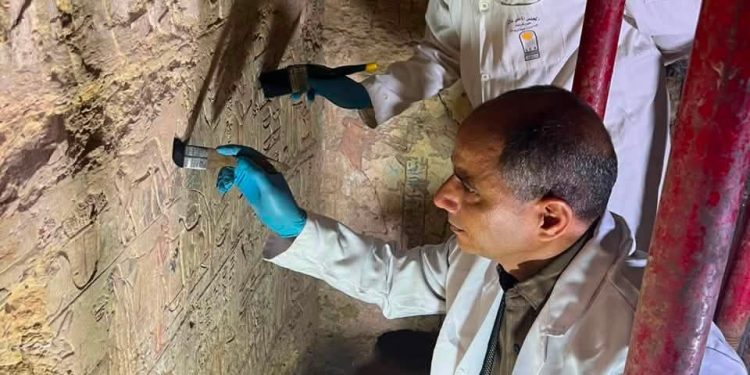
An Egyptian archaeological mission in the Bubasteion necropolis in Saqqara has uncovered three rock-cut tombs dating back to the New Kingdom period.
An expert in Egyptian antiquities and director of the Zahi Hawass Foundation for Antiquities and Heritage, Ali Abu-Dashish, said that the new archaeological discovery has shed light on the administrative, military, social, and political aspects of the Egyptian state during that era.
Speaking to Al-Masry Al-Youm on Monday, Abu-Dashish added that Saqqara area still holds archaeological treasures capable of reconstructing aspects of life in ancient Egypt.
Excavation work is still ongoing inside the burial shafts of the three tombs, he said, which opens the door to new discoveries that may reveal more information about the lineage of the tomb owners and their administrative and military roles, adding new chapters to the history of the Saqqara necropolis, one of the richest archaeological sites in Egypt.
The Ministry of Tourism and Antiquities announced the discovery of the three tombs during scientific excavations in the eastern sector of the mountain ridge at the site.
This new archaeological find sheds light on the history of the ancient Memphis necropolis and adds information about prominent figures in the state and society of that era.
The Director General of the Saqqara Archeological Area, Amr al-Tayyeb, revealed that the first tomb belongs to a man named Mentuhotep and contains elaborate scenes of offerings and hunting.
He added that the second tomb belongs to a man named Bar-em-Waya, also known as Samut, who held the title of Chief Merchant of the House of Ptah, and the third belongs to a man named Nehsy.