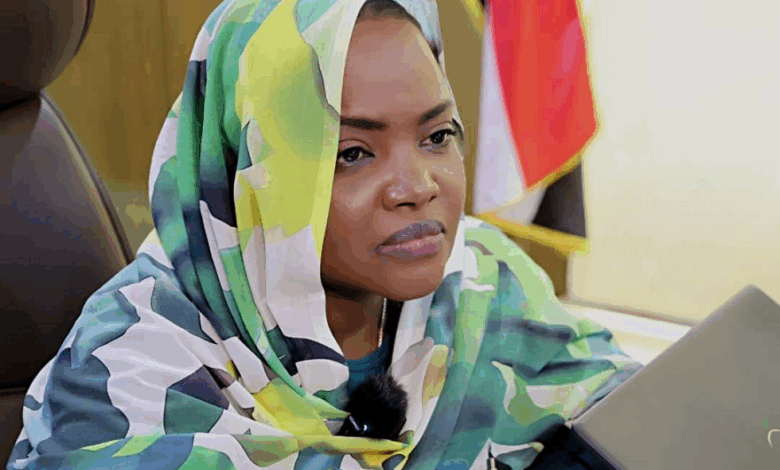
Sudan’s Minister of State for Social Welfare and Sustainable Development, Salma Ishaq, sat down for an exclusive interview to offer a concentrated field-based assessment of the structural transformations reshaping the Middle East, positioning Sudan as a revealing testing ground for the ongoing reconfiguration of the region.
The minister argues that the Middle East has moved beyond “using terrorism” as a tool to destabilize states and has entered a far more complex stage in which proxy wars intersect with strategies aimed at dismantling the nation-state from within.
According to her, these dynamics are redistributing influence while weakening social cohesion and regional stability.
She warns that what is unfolding in Sudan is not an isolated incident, but comes as part of a broader strategic pattern that could extend to other arenas – particularly in the Horn of Africa and the Red Sea, where strategic waterways intersect with fragile security environments vulnerable to escalation.
The minister places Israel and America’s actions at the center of these transformations, arguing that Israel’s expansion toward strategic spheres such as the Red Sea and the Horn of Africa reflects a transition toward a new model of power projection.
She contends that Israel is seeking to militarize maritime corridors, describing the move as a “ticking time bomb” threatening Arab national security.
Ishaq concludes that the region is facing a critical test of sovereignty, alliances, and deterrence amid the absence of an effective Arab framework capable of producing strategic balance in the face of this accelerating shift.
Interview:
“ISIS and Boko Haram were not accidents”
How do you assess the situation in the Middle East amid the ongoing conflicts and the dominance of logic of force?
• What we are witnessing in the region is a process of redrawing maps that did not emerge overnight, but instead represents a cumulative project that has been in the making for a long time. What has now come clear is that many of us underestimated these scenarios and dismissed them as “conspiracy theories” until they became tangible reality.
There have always been attempts to pin accusations on specific groups or states in order to justify intervention in the region, despite the fact that the very powers destabilizing our region had, at earlier stages, maintained alliances with forces they now classify as terrorist organizations.
Therefore, groups such as ISIS and Boko Haram were not accidental developments, but rather products of functional engineering that were later turned against themselves.
This is why I agree with the remarks made by Egyptian President Abdel Fattah al-Sisi that our region is facing malicious plots aimed at reshaping it.
“Israel’s strategy relies on fragmenting domestic environments before imposing influence”
Do you mean that attempts to redraw the region have moved beyond the use of terrorism toward a more complex pattern based on manufactured crises and proxy wars?
• Proxy wars have become one of the most prominent tools currently being used in the Middle East. What is happening in Sudan cannot be separated from this context – it is part of a broader process of reshaping and re-engineering the Middle East according to new modes of political control and influence management.
Unfortunately, the region has moved from exploiting terrorism to destabilize states into a far more dangerous stage — one centered on self-destruction and internal fragmentation through proxy wars.
To what extent do Israel’s actions — particularly in the Red Sea — represent a shift in the rules of conflict and a direct threat to Arab national security?
• Israel’s recognition of the so-called “Somaliland” is evidence of its drive toward the militarization of maritime corridors. This issue threatens the entire region and undermines the stability of its states, not least because it could lead to the emergence of anti-Israeli groups.
This may open the door to a wider expansion of conflicts, not only within Sudan but across the region as a whole.
Israel seeks to create new arenas of conflict in order to erode the levers of control held by some regional states. Even countries that believe they can neutralize Israel through unconditional normalization will ultimately remain vulnerable. Just as Israel has exploited the war in Sudan, it is now seeking to use Somaliland and transform it into a platform for regional threats, making it a direct strategic threat.
Israel’s efforts to establish a military base in the region are a ticking time bomb, as its strategy relies on fragmenting internal environments before imposing its influence and dominance.
“Egypt’s engagement in sensitive issues such as Gaza, Lebanon, and Sudan has provided the region with a degree of balance.”
Egypt proposed the establishment of a joint Arab force in 2016 to confront challenges and attacks against Arab states, while earlier concepts of collective security never materialized. How do you view this issue? And is the idea of an “Arab NATO” realistically achievable?
• Egypt’s proposal to establish a unified Arab force is extremely important and consistent with the approach adopted by major international blocs, whether in Europe or elsewhere. The existence of a unified Arab force capable of protecting Arab interests would lead to genuine balance in the region.
However, this topic has repeatedly been obstructed as it unsettles certain powers.
Any union of this kind would generate greater collective strength and reshape regional balances of influence. This may partly explain why the project has stalled, and it may also explain concerns over attempts to target the role of pivotal states such as Egypt because of their geopolitical weight and regional influence.
Here, I would also recall the statements made by an Israeli researcher with an intelligence background, Mordechai Kedar, who called Egypt Israel’s “primary enemy.”
Such rhetoric reflects Israel’s awareness of Egypt’s strategic weight and influence.
Egypt remains one of the largest Arab powers, and its geographic proximity and shared border with Israel give it particular significance. Egypt’s ability to manage this balance and navigate its consequences makes it a power that cannot be ignored.
For this reason, Egypt’s reaction continues to be closely monitored by Israel and other international actors alike.
Egypt’s actions — from the war in Gaza, to Lebanon, and all the way to Sudan — have played an important role in disrupting or at least complicating plans aimed at redrawing the region.
Its presence in every regional equation, whether on the Arab or African level, remains impossible to overlook or bypass.
Economics and politics are two sides of the same coin. What kinds of economic and security blocs could emerge amid the ongoing redistribution of power balances?
• Israel is likely to move toward forming economic blocs with certain Gulf states as part of a transitional reshaping of regional power balances.
As for the discussion surrounding Israel’s recognition of the so-called “Somaliland”, although such a move may isolate it strategically from broader regional arrangements, it nonetheless remains a likely source of security threats.
I would not rule out Israeli efforts to build a joint security and economic alliance with Somaliland.
We should not forget that the territory was reportedly used in military operations against Sudan, as drones targeting Sudan’s territorial integrity were launched from Somaliland. This means such operations could potentially expand toward other parts of the Arab region.
Israel’s cooperation with Somaliland therefore constitutes a direct strategic threat to regional security.
Sudan’s experience has demonstrated that true protection can only be achieved through the construction of effective interests and alliances, particularly amid escalating competition over vital resources such as the Red Sea, ports, and coastlines.
As Arabs, we must recalibrate the direction of our alliances toward powers such as Russia and China in order to safeguard Arab interests and establish regional blocs independent of the United States and Israel.
What strategic mistakes did Arab actors make in Sudan — and earlier in Somalia — and how did these failures open the door to regional and international intervention?
• The most significant Arab mistake regarding Sudan was the failure to recognize early on that the conflict was a proxy war. Instead, it was largely treated as an internal conflict or merely a war between two generals — the same narrative adopted by the international community.
This obscured the true nature of the war as a proxy conflict driven by regional and international actors.
With the exception of Egypt’s position, had there been an earlier Arab awareness of the nature of the conflict in Sudan and of the regional ambitions surrounding Red Sea ports, the regional response might have been very different.
Today, this awareness is beginning to emerge, particularly as the scale of regional ambitions tied to the Red Sea and its strategic ports becomes increasingly evident.
In Somalia, meanwhile, the problem lay in leaving the country alone to confront its overlapping crises — whether those related to state fragility, internal conflicts, or the presence of groups such as Al-Shabaab.
There was no coherent and unified Arab position, which only allowed the crisis to further deepen.
What we now see through Israel’s growing presence in the Somaliland region is an attempt to destabilize the broader area. Israel’s strategy does not usually begin with direct control, but rather with an initial phase centered on destabilization and the creation of conflict zones.
Its relations with Somaliland appears to be part of an effort to unsettle and reshape the region through the explosion of its internal contradictions.
Israel’s strategy relies on fragmenting domestic environments before imposing influence.
The biggest threat is that what is happening in Sudan is not an exception, but comes as part of a strategic pattern that may spread across the region.
Given the imbalance of power in the region, can Egypt’s support for the Sudanese army and state institutions be viewed as a model for protecting the nation-state against fragmentation scenarios?
• The objective of the war was to destroy state institutions.
Based on its understanding of Sudan’s nature and strategic importance, Egypt moved in the right direction from the outset. Egypt supported the institutional state in the face of fragmentation scenarios, acted as a regional pillar for Sudan, opened its doors to Sudanese citizens, and sent bold and direct messages through its position on Sudan to both regional and international actors driving the conflict.
Egypt’s participation in the groupings concerned with ending the war in Sudan have also reassured many Sudanese people.
Egypt’s presence within the “Quad and Quint mechanisms” led Sudanese society to view Cairo differently, because Egypt understood early — by virtue of geography and history — that any instability in Sudan would directly impact Egypt’s national security.
For this reason, Egypt adopted a distinct position, whether through supporting Sudanese state institutions or hosting Sudanese refugees. This approach reflects a deep understanding of the interconnectedness between the two countries and serves as a model for what the broader Arab position toward Sudan — and previously Somalia — should have looked like.
Accordingly, Egypt’s presence in sensitive regional issues such as Gaza, Lebanon, and Sudan provides the region with a degree of balance.
It not only serves regional stability but also protects Egypt’s own national security, because the crises surrounding the region impose an advanced and unavoidable role for Cairo.
In a regional environment governed by power balances and influence, Egypt’s active role is a strategic necessity rather than a matter of choice.
How has the war reshaped Sudan’s social and economic structure after the country had once been viewed as a potential breadbasket for the region?
• What has happened in Sudan after three years of a war aimed at dismantling the state cannot merely be described as a security deterioration – it is a comprehensive collapse that has reached every aspect of life.
The reality has changed fundamentally. Society has moved from a state of relative stability — despite its challenges — to a daily struggle for survival in securing food, safety, and medicine. The conversation is no longer about the future, but about ensuring the minimum requirements just to stay alive.
The war has produced shocking realities and staggering figure: the number of displaced persons and refugees has reached nearly 16 million people living under extremely fragile conditions — a massive figure that reflects the utter scale of the catastrophe.
UN estimates indicate that 76 percent of women no longer feel safe. How should this indicator be understood within the broader patterns of conflict-related violence and the use of sexual violence as a weapon of war?
• Women and children are the groups most severely impacted by this war.
Women were first subjected to widespread economic violence and stripped of their savings and livelihoods. A large percentage of workers in the informal sector — around 70 percent — were women, and they are now unable to continue their work under conditions of displacement and refuge.
The most dangerous aspect of the war is the use of sexual violence as a political weapon linked to the conflict. It has been systematically employed as a tool to destroy communities and force populations into displacement.
We have documented more than 2,200 cases of conflict-related sexual violence intended to drive forced displacement since the outbreak of the war.
However, these figures represent only the minimum estimate, as many incidents go unreported due to the absence of services, fear, and social stigma. It is impossible to fully document the scale of violations while the conflict remains ongoing.
“The Rapid Support Forces used sexual violence against women as a tool of political and ethnic retaliation.”
The Rapid Support Forces targeted girls as young as five years old and women up to the age of 85. Reports by UNICEF and the United Nations Population Fund point to rising levels of gender-based violence in conflict zones. How has this affected the phenomenon of forced child marriage in Sudan?
• The cases that have been documented point to around 176 incidents of forced marriage, though this reflects only a fraction of the reality.
What is taking place cannot truly called marriage – it is a form of sexual exploitation linked to conflict conditions, carried out under coercion and without consent.
In addition, 293 cases of sexual violence against girls under the age of 18 have been documented.
This aligns with repeated international warnings that children and girls represent the most vulnerable segment of populations affected by armed conflicts.
According to data from Médecins Sans Frontières, more than 4,000 survivors of sexual violence have been received and treated. How do you interpret these figures in comparison to the actual scale of the crisis?
• These figures reflect only the visible portion of the crisis. In conflict environments, access to healthcare services remains extremely limited, while social stigma and fear prevent many survivors from reporting abuse.
As a result, the documented cases represent only the minimum estimate. Within similar contexts, UN assessments generally indicate that the real numbers are significantly higher and may only become fully visible after the conflict comes to an end.
Are there national mechanisms in place to document crimes committed by the Rapid Support Forces? And what is the government’s plan for addressing the consequences of the war? Are psychosocial support programs sufficient to deal with the war’s deep social impact?
• The recorded figures do not fully reflect the reality, and it is impossible to determine the total number of victims before the war ends, because the conflict itself prevents access to many affected communities.
The war obstructs the collection of accurate information, and the complete scale of violations will likely only emerge after the fighting stops.
Reports issued by organizations such as Médecins Sans Frontières, alongside documentation gathered by the United Nations, reveal the scale of abuses, particularly in hard-to-reach areas such as Darfur.
These regions are subjected to systematic policies of subjugation in which multiple tools are employed — including sexual violence and starvation — with the aim of controlling populations, especially African tribes.
From the perspective of your responsibilities, how do you envision the reconstruction of Sudan?
• There are sector-specific reconstruction plans covering infrastructure and essential services, including electricity, water, healthcare facilities, and community centers.
International experience, however, demonstrates that reconstruction is not based on funding alone but also on partnerships.
We are counting on friendly nations, international partners, and Sudan’s own human resources.
Egypt, for example, can help Sudan assess the scale of damage, while UN organizations can play an important humanitarian role.
Major reconstruction projects still require broader investments tied to shared interests, and we are relying on Sudan’s partners in the Arab region once the war ends.
Before moving toward reconstruction, we must also undertake structural reforms in the mining and agricultural sectors so they can serve as pillars of the Sudanese economy.
Amid the dynamics of fragmentation that often accompany conflicts, is preserving Sudan’s unity still a realistic option? And what is required to contain societal fragmentation after the crimes committed by the Rapid Support Forces?
• The geographic partition of Sudan is not an acceptable scenario.
Preserving Sudan’s unity remains the strategic option, because division would not simply mean redrawing borders — it would amount to dismantling national identity itself.
In regions such as Darfur, there are fears of demographic changes that could trigger prolonged conflicts not only within Sudan, but across its regional environment, including the Sahel and West Africa.
For this reason, partition could become a permanent generator of instability.
If a partition scenario were to occur, how would it affect regional security, particularly in the Horn of Africa and the Sahel?
• Any partition would lead to the expansion of conflicts and the emergence of new flashpoints.
This, in turn, could fuel irregular migration networks, accelerate the spread of weapons, and pose broader threats to regional security — patterns that have already been observed in the experiences of other states.
Finally, where is the region heading, and who is shaping the outlines of its future?
• Unfortunately, the contours of the region’s future are currently being shaped primarily by influential powers such as Israel and the US, alongside both declared and undeclared dealings with certain regional states.
In the absence of a unified Arab position, we are facing two possible trajectories.
The first is a pragmatic path based on Arab states building new economic and security blocs that protect their interests independently of the United States and Israel. The second is surrendering to the existing reality, allowing prolonged conflicts and proxy wars to continue expanding.
There is a real danger that the conflict in Sudan could spread into a broader regional confrontation.
If Israel fails at this stage in its attempts to absorb more Arab territories alongside the partition of Sudan, it is likely to continue creating new conflict zones elsewhere — whether in North Africa, East Africa, or West Africa, and potentially in other Arab states as well.
This strategy is fundamentally based on sustaining conflicts until its desired geopolitical objectives are achieved.