The US plan to “guide” ships through the Strait of Hormuz, announced by President Donald Trump just hours before it went into effect, leaves a lot of unanswered questions.
US Central Command said in a statement on X that its support for the operation, dubbed Project Freedom, “will include guided-missile destroyers, over 100 land and sea-based aircraft, multi-domain unmanned platforms.”
But how those military assets figure into getting merchant ships moving through the strait again is not defined.
Jennifer Parker, a nonresident fellow at the Lowy Institute and a former Royal Australian Navy officer, told CNN Monday that she expects the US military to increase its presence in and over the strait to provide reassurance to commercial vessels attempting to transit it.
“This appears to be an operation … which is less about providing direct protection to a vessel or a couple of vessels and more about trying to change the situation in the strait” so ships “feel safe,” Parker said.
That mission could include a few US Navy ships in the strait and a range of aircraft flying over it that could spot and take out any small boats or ships trying to attack commercial vessels, she said.
While a convoy escort operation, with US destroyers steaming alongside merchant ships, is unlikely, according to Parker, she said an increase of US warships going through the strait would be a positive move.
That’s because to stop the operation, Iran would have to directly confront the US Navy, something it has not done to date.
“In some ways (Trump) is forcing Iran’s hand,” she said.
“They would need to escalate and fire at US warships, which is a different level of escalation,” Parker said.
Trump’s announcement of the plan drew a quick rebuke from Iran, with Ebrahim Azizi, the head of the Iranian parliament’s National Security Commission, warning that that any US interference in the Strait of Hormuz would be considered a violation of the ceasefire that has been in effect since April 8.
“The Strait of Hormuz and the Persian Gulf would not be managed by Trump’s delusional posts!” he said in a post on X.
“Any foreign military force, especially the invading American army” will be attacked if they try to approach or enter the Strait of Hormuz, the commander of the Iranian armed forces’ Khatam al-Anbiya Central Headquarters said, according to Iran’s Fars news agency reported.
Trump earlier said any “interference” from Iran would be met with “force.”
Shipping execs not convinced
Shipping executives are not convinced the new US plan lessens the risk. “It takes both sides to unblock — not just one,” Bjørn Højgaard, CEO of ship manager Anglo-Eastern told CNN.
So far in the war, Washington has been reluctant to put US Navy warships within range of Iranian shore-based anti-ship missiles or small attack craft that Tehran can field in numbers in and around the Strait of Hormuz.
CENTCOM has only acknowledged US destroyers going through the strait on one occasion, on April 11 when two US destroyers transited the waterway “as part of a broader mission to ensure the strait is fully clear of sea mines.”
Parker said it was surprising the US has not done more missions into the strait since then to encourage shipping to try to go into the waterway, but she supported Trump’s Sunday announcement.
“You can’t allow Iran to maintain the status quo, which is de facto control of the strait,” she said.
Parker was careful not to equate operations in the strait with the blockade of Iranian ports the US has been maintaining since April 13.
While that has seen Washington interdicting dozens of Iran-linked ships, those operations have taken place well back from the entrance to the strait.
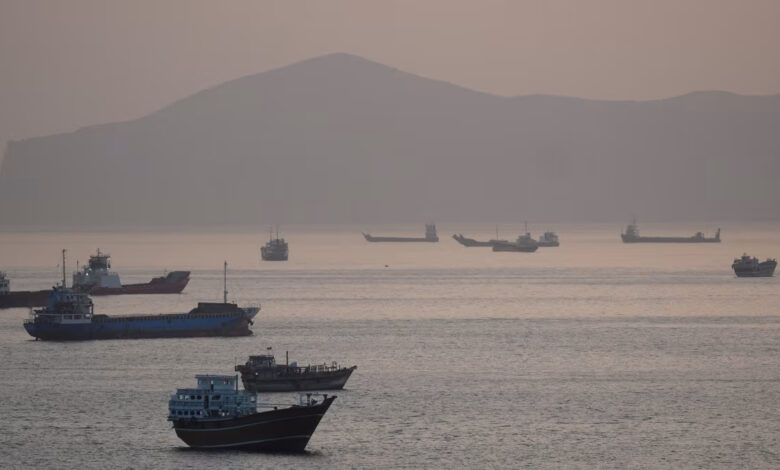
That’s because the strait is a narrow waterway, about 24 miles wide at its narrowest point. But tankers move through much smaller channels about two miles wide, distances that make boarding operations more difficult and dangerous, Parker said.
Tight waterways also make escorting convoys problematic, as there is little room to maneuver to avoid threats.
The Iranian forces that could threaten escort missions in the strait are dispersed and mostly mobile. Drones and missiles can be launched from trucks and mines could be deployed from untold numbers of small fishing boats, dhows or even pleasure craft, experts said.
“Are you going to be able to destroy all those vessels to eradicate the threats?” asked Collin Koh, research fellow at the S. Rajaratnam School of International Studies in Singapore.
“To me, it’s not very feasible,” Koh said.
But even if the US wanted to take that risk, experts questioned if Washington has enough destroyers in the Middle East to perform convoy duty.
“We don’t have the assets to do traditional convoy ops,” said analyst Carl Schuster, a former US Navy captain.

During the so-called Tanker War of the late 1980s, US warships escorted reflagged Kuwaiti tankers in the Persian Gulf. Those missions – called Operation Earnest Will – involved several US vessels escorting a convoy of just a few tankers.
For instance, the first escort convoy on July 22, 1987, had two commercial ships escorted by five US Navy and Coast Guard ships.
The US doesn’t appear to have enough assets in the region to mount similar escorts now. As of April 24, the US Navy had 12 destroyers in the Middle East, CNN has reported.
But not all could be devoted to strait escorts. Some will be doing blockade enforcement. Others would need to stay with aircraft carriers as the destroyers provide the primary air defense for the carrier strike groups.
“This is why I don’t think they are talking about close-escort operations,” Parker said.
“I think they’re talking about presence operations to be in a position to respond if Iran tries to attack shipping.”
Kristie Lu Stout contributed reporting.