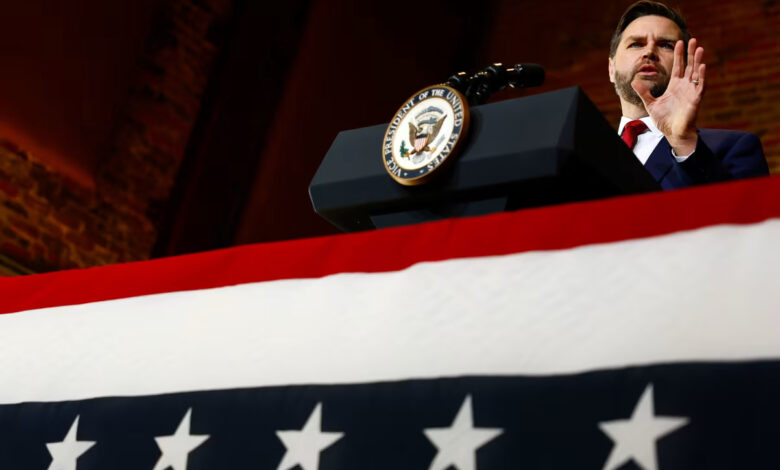
Mere hours after President Donald Trump ordered strikes on Iran’s nuclear program last June, his vice president appeared on two separate Sunday shows to hail the success of the mission. JD Vance was so effusive that he used the word “incredible” or “incredibly” four times in less than one minute.
Within hours of Trump’s operation to capture Venezuelan President Nicolás Maduro in January, Vance was on X posting a combative defense of the legality of the operation.
It’s now been two weeks since Trump launched a war with Iran, and Vance has yet to offer anything like these public votes of confidence.
That continued Friday, when he was asked by a reporter what he had advised Trump initially and more recently.
Vance gave an extended answer but punted on giving his personal view of the war.
“I hate to disappoint you, but I’m not going to show up here and, in front of God and everybody else, tell you exactly what I said in that classified room,” he told reporters in North Carolina, referring to the Situation Room.
“Partially because I don’t want to go to prison, and partially because I think it’s important for the president of the United States to be able to talk to his advisers without those advisers running their mouth to the American media,” he continued. (It’s not clear how Vance sharing his opinions would be a crime, and he was asked more broadly about his advice to Trump, not anything classified.)
It was a strange answer — but a telling one when it comes to how Vance has avoided this subject.
In fact, his most newsworthy comments to date have been his assurances that the war wouldn’t be a prolonged one.
Vance’s lack of strong public support has been conspicuous for a while, but it’s getting even more so.
CNN has reported that Vance initially counseled against another Middle East war but shifted his stance when it became clear Trump favored military action and advocated for the president to attack quickly and decisively. The vice president’s initial reservations square with his past commentary espousing the virtues of non-interventionism.
As a senator, he wrote an op-ed in 2023 arguing that Trump was a successful president in large part because he stayed out of wars. In 2024, he said war with Iran, specifically, was not in the US’ interest and would be a “huge distraction of resources.” He warned about war in 2020 when Trump ordered the killing of an Iranian commander. And private messages from “Signal-gate” last year suggested he was skeptical of Trump’s strikes on Yemen’s Houthi rebels.
But he is Trump’s vice president. And for a president who often demands obsequious fealty from those around him — including his No. 2 — it’s been astonishing to see Vance try to keep his powder at least somewhat dry.
Critics of the administration will see politics at work — i.e. Vance trying to insulate himself ahead of the 2028 presidential campaign. But his hands-off approach could be a political liability too.
With the war polling poorly in most surveys, the White House has often pointed to its strong support within the MAGA movement. Yet here is the second-most powerful MAGA politician in the country who won’t even lend too much of his political support.
And it’s not terribly subtle, either.
While Vance was quick to take to X to defend the administration after the Venezuela operation in January, he’s been very quiet on social media the last two weeks. In fact, he’s posted just eight times on his personal account since the war began. (It’s worth noting, however, that Vance seems to have taken a step back on social media in recent months, even before the war began.)
While some of the posts on his personal and official accounts are about Iran, those are mostly about killed service members and sharing Trump’s comments rather than Vance’s own. He also posted an interview he did with Fox News about Iran.
But while the subject of that March 2 interview was Iran, Vance largely avoided giving his opinion on the war.
Tellingly, he repeatedly pointed to what Trump was thinking or saying: “the president was looking”; “the president determined”; “he saw that”; “he wanted to make sure”; “the president’s been extremely clear”; “the president just wants”; “the president’s objective”; and “the president will be happy.”
To some degree, that’s Vance job — to talk about the president’s views. But after the June strikes on Iran’s nuclear program, he spoke much more in terms of what he, personally, thought and felt.
And the big headline from that Fox appearance was Vance assuring that this wouldn’t be a decades-long process like in Iraq and Afghanistan.
His other public appearances have been short on Iran comments. He briefly mentioned the killed service members in a speech to the International Association of Fire Fighters on Monday. And in Friday’s speech in North Carolina, he kept mostly to the economy.
Vance is not the only one who’s been asked about daylight between him and the administration. When asked about this subject, neither Trump nor Defense Secretary Pete Hegseth have protested too hard about the idea that Vance is in a different place than the president.
When Trump was asked Monday if there was any disagreement between him and Vance, he responded, “I don’t think so. No. No. We get along very well on this.”
But then he suggested there was something to it: “He was, I would say, philosophically a little bit different than me. I think he was maybe less enthusiastic about going, but he was quite enthusiastic.”
Asked on Friday whether there is a “division” between Vance and Trump, Hegseth avoided a direct answer.
“As far as the vice president, he’s an incredible member, leader of this team as well, alongside the president and the secretary of state,” Hegseth said, adding that this team gives Trump options, “and the vice president, every single day, is a key voice in that — an indispensable voice in that, actually.”
For whatever reason — be it philosophical, political or both — Vance isn’t giving us anything to dispute the narrative that he’s not fully on board. And the administration is allowing him to keep his distance.
But it remains to be seen how long that posture can be maintained the longer the war goes on.