
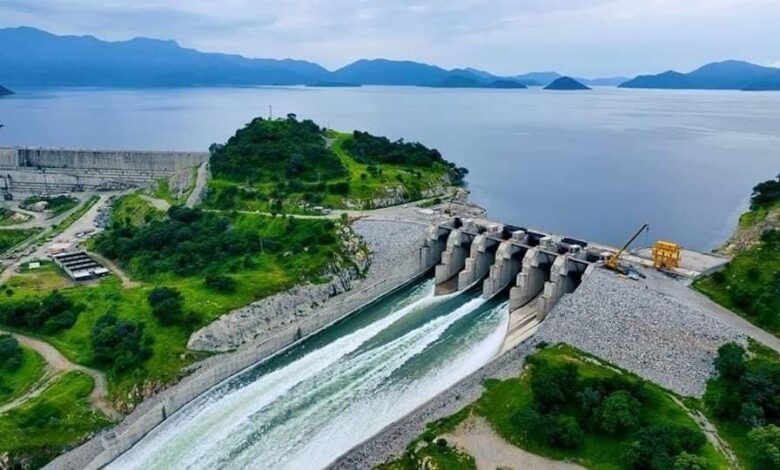
Renowned Egyptian water resources expert Abbas Sharaky has disclosed a new technical insight regarding the actual storage capacity of the Grand Ethiopian Renaissance Dam (GERD) reservoir, asserting that it stands at 64 billion cubic meters (bcm) rather than the 74 bcm figure publicized by Addis Ababa.
In an exclusive interview with Masrawy, Sharaky clarified that Egypt’s dispute over the mega-dam is not about its name, nor whether it is framed as a project for development or destruction.
Instead, he emphasized that the issue hinges on a core principle of international law: Ethiopia unilaterally constructed the project on an international, transboundary river—the Blue Nile, which supplies 60 percent of the Nile’s total waters—without adhering to global norms or governing treaties.
“Had Ethiopia abided by international guidelines for projects on transboundary rivers, we would not have opposed any developmental initiative on the Nile,” Sharaky stated. “However, imposing a political fait accompli is something that both Egypt and Sudan have fundamentally rejected from 2011 to this day.”
Construction finished, debate ongoing
Despite the official announcement of the dam’s completion and inauguration last September, Sharaky stressed that the real discourse does not revolve around turbine operation. Rather, the critical focus remains on the annual volume of water reaching Egypt and the management mechanism of the reservoir, which Addis Ababa began filling in 2020.
The technical twist: The emergency middle spillway
The Egyptian expert highlighted specific engineering details in the dam’s design, noting that the executing contractors lowered the center of the dam’s main body by 5 meters compared to its flanks across a width of approximately 220 meters to construct an emergency “middle spillway.”
This structural feature is designed to rapidly discharge excess water during emergencies through the central channel, preventing water from overtopping the dam’s sides and flooding the power generation stations, which could otherwise cause catastrophic damage.
How design alters storage math
Sharaky explained the direct mathematical impact of this engineering choice: “At this specific elevation, each meter of water depth in the reservoir equals roughly 2 billion cubic meters of storage. Consequently, lowering the center by 5 meters translates to a capacity loss of approximately 10 billion cubic meters.”
Therefore, given the structural presence of this middle spillway, the actual maximum storage capacity of the GERD reservoir is 64 bcm, contradicting the officially advertised 74 bcm.
Why Addis Ababa sticks to the 74 billion figure
Sharaky suggests that Ethiopia’s insistence on the 74 bcm figure is driven by political and media public relations aimed at avoiding admitting to the Ethiopian public that the actual capacity is lower than initially promoted. Nevertheless, he noted, “64 billion is still a massive volume, but the scientific truth must be stated clearly.”
Implications for Egypt and Sudan
Sharaky concluded by noting that the actual storage capacity of 64 bcm was officially reached in August 2024. However, turbine operation was limited at the time, forcing the opening of the spillway gates to discharge excess water.
He underscored that Cairo is meticulously monitoring the reservoir’s water levels, as any shift in operational strategies or structural design directly affects Egypt’s vital share of Nile water—a red line that cannot be crossed without legally binding guarantees protecting the rights of all three nations.
