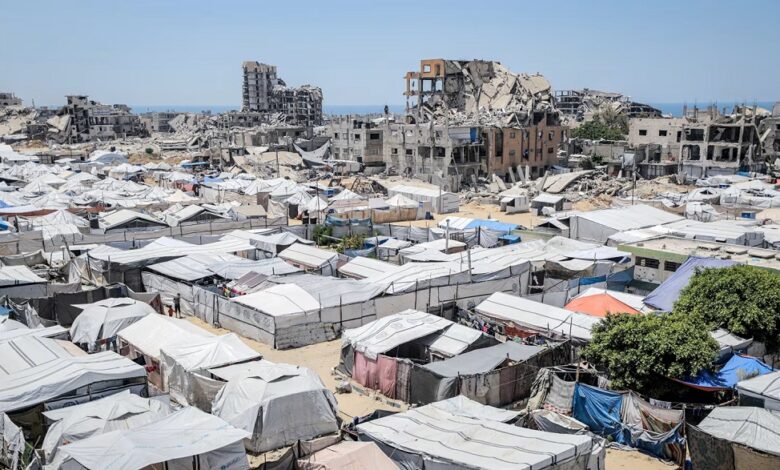
Minister of Foreign Affairs, International Cooperation and Egyptian Expatriates Badr Abdelatty said Egypt will continue intensive contacts with Qatar, Turkey, and Palestinian factions, including Hamas, stressing that efforts have not stopped and that an Israeli withdrawal from Gaza is necessary in line with US President Donald Trump’s plan.
He made the remarks in response to journalists’ questions during a joint press conference on Saturday, July 04, 2026, with EU Commissioner for the Mediterranean Dubravka Šuica.
Abdelatty emphasized that these contacts “have not and will not stop,” adding that Egypt is working to reach a consensus on two primary issues: weapons control and collection, and the total withdrawal of Israeli forces from the Gaza Strip, in preparation for implementing the second phase of Trump’s plan.
He stressed that Egypt will continue its efforts and exercise maximum patience to encourage positive engagement with proposals on arms control based on a paper submitted to Palestinian factions, including Hamas.
Separately, the Foreign Minister stated that efforts are ongoing within the four-party framework—and through continuous contacts with the United States, Iran, and other key nations—to keep negotiations progressing at the technical level, highlighting the recent quadrilateral meeting hosted in Cairo.
On the main areas of cooperation between Egypt and the European Union in the coming phase, European Commissioner for the Mediterranean Dubravka Šuica said resilience, preparedness, and migration are interconnected pillars under the Mediterranean Pact, stressing that the EU is working to support talent and partnerships and that Egypt is an indispensable partner for the European Union.
During the press conference, Šuica said preparedness and migration “will lead us to prosperity,” adding that the EU is engaged in this process and emphasizing the importance of human development.
For his part, Abdelatty said there is an important project with Greece on legal migration, through which both sides can “benefit and gain.”
Regarding key initiatives with the European Commission and areas of progress, Abdelatty said there is mutual commitment to fully implementing the comprehensive strategic partnership agreement.
He noted that €1.8 billion is allocated by the European Union to support the private sector and investment, stressing the importance of ensuring Egyptian companies benefit from this support.
He added that Egypt aims to become a hub for new and renewable energy, pointing to interest from European companies as well as non-EU countries such as Norway.
He also referred to some regulatory obstacles affecting Egyptian exports to European markets, calling for technical support for renewable energy projects and capacity building.
Šuica emphasized the importance of regional stability, noting that grants already exist but stability is needed to encourage European investors to come to the region.
She also said there is consideration of a financing platform worth €10.8 billion, adding that the green transition is very important and must proceed step by step.
Abdelatty responded that Egypt has adopted laws and regulations to facilitate and encourage investment, stressing commitment to further empowering the private sector.
On the EU’s assessment of Egypt’s efforts to combat irregular migration, Šuica said Egypt is an indispensable partner in the region, particularly on irregular migration, adding that the EU is committed to sustaining this partnership and supporting authorities in these efforts.
She praised Egypt’s strong efforts, describing migration as a major, sensitive global issue.