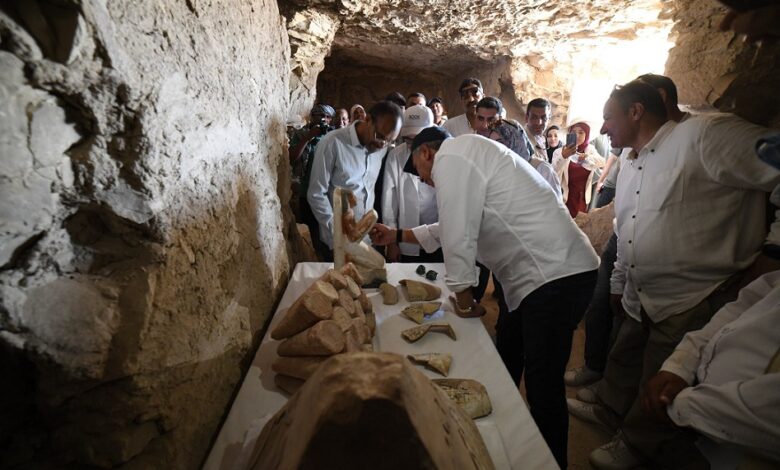
Minister of Tourism and Antiquities Sherif Fathy inspected ongoing archaeological excavations in the Dra’ Abu al-Naga area on Luxor’s West Bank, as part of his tour to monitor the progress of archaeological projects in the governorate.
The minister reviewed the latest discoveries made by the Egyptian archaeological mission affiliated with the Supreme Council of Antiquities and received a detailed briefing on their excavation work, which began in November 2025.
Th
The Secretary-General of the Supreme Council of Antiquities, Hisham al-Leithy, explained that this is the mission’s eighth season and focused on the southeastern section of the tomb of Roy (TT255), an area that had remained covered by debris from previous excavations for over 150 years.
The mission’s work uncovered 10 well-preserved wooden coffins inside a burial shaft in the courtyard of the tomb of Baki.
These coffins bear various inscriptions dating back to different historical eras.
Ancient coffins
Preliminary studies revealed that four of the coffins date back to the 18th Dynasty, including one bearing the name of Merit, a singer of the god Amun.
Another coffin dates to the Ramesside period and bears the name of Padi-Amun, who served as a priest in the Temple of Amun.
The remaining coffins belong to the Late Period.
Leithy indicated that the studies suggest the shaft was used as a cache to store the coffins after they were moved from their original burial sites in order to protect them, especially given the deteriorating condition of the mummies inside.
The mission also succeeded in uncovering the tomb of the purification priest of the Temple of Amun, A-Shafi-Nakhtu, located in the southern corner of the courtyard of the tomb of Baki.
It comprises a small courtyard, a rectangular shaft, and an entrance decorated with offering scenes and funerary texts, leading to a rectangular hall that ends in the burial chamber.
The tomb’s facade bears the names of its owner’s two wives, Isis and Ta-Kafet, both of whom held the title “Singer of the Temple of Amun.” His father, Padi-Amun, is also named with the same title.
Among the discoveries was a sandstone pyramidion found inside a small tomb, DP91, bearing the name “Benji” and the title “Scribe and Noble,” depicted in a recurring devotional pose. The location of his original tomb has not yet been determined.
The Director General of Luxor Antiquities, Abdel-Ghaffar Wagdy, confirmed that the mission is currently continuing its scientific documentation and meticulous restoration work on the discovered coffins and artifacts, in preparation for the comprehensive announcement of the study’s findings.
He noted that the owners of the discovered tombs have not been mentioned in any previously known historical sources.
Wagdy added that the discovered inscriptions document new titles and positions mentioned for the first time, representing an important addition to the study of ancient Egyptian history and the understanding of the administrative and social structures of those historical periods.
Edited translation from Al-Masry Al-Youm