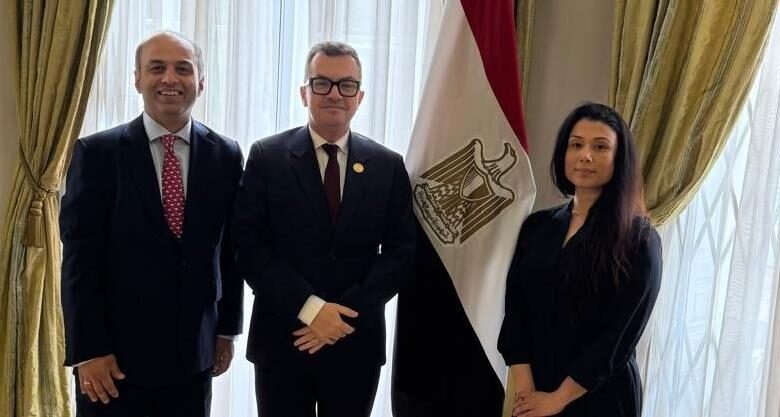
Minister of Planning and Economic Development Dr. Ahmed Rostom affirmed on Tuesday, May 19, 2026, that the government is targeting economic growth between 5.2 percent and 5.4 percent in the next fiscal year, supported by the continuation of economic reform measures.
He noted that growth during the first half of the current fiscal year had already reached 5.3 percent, confirming the positive impact of reforms on the real sectors of the economy.
This came during a series of intensive meetings held by the minister with representatives of major international financial institutions and the private sector while participating in the Oxford Africa Conference 2026, held at the University of Oxford in the United Kingdom under the theme: “Repositioning Africa: Leadership in an Age of Disruption.”
The meetings reviewed the resilience of the Egyptian economy in facing ongoing regional and international challenges, as well as the state’s efforts in implementing the economic reform program. The meetings were attended by Egypt’s Ambassador to London, Ambassador Ashraf Sweilam, and Minister Plenipotentiary for Trade Wael Abdel Rahim, Head of the Egyptian Commercial Office in London.
The Minister held bilateral talks with Saif Malik, CEO of Standard Chartered Bank; Chris Chijiutomi, Managing Director and Head of Africa at British International Investment (BII); Patrick Brang, Managing Director and Head of Infrastructure Finance for Europe and the Americas at HSBC; Hamish Patel, Head of the Public Sector for Europe, the Middle East, and Africa at HSBC; in addition to Fumik Noor Shah, Head of Origination at UK Export Finance.
During the meetings, Rostom reviewed developments in the Egyptian economy and the measures taken to support macroeconomic stability and improve the investment climate.
The minister revealed that economic growth in the first half of the current fiscal year showed notable improvement, reaching 5.3 percent. He added that the development plan for fiscal year 2026/2027 aims to achieve a growth rate ranging from 5.2 percent to 5.4 percent.
Rostom added that the current growth rates confirm the positive impact of economic reform decisions on productive and service sectors. Accordingly, the government aims to increase the positive contribution of real economy sectors to growth in the next fiscal year, with five sectors accounting for 64 percent of the targeted economic growth in 2026/2027.
Manufacturing industries are expected to lead with 29 percent, followed by wholesale and retail trade at 11.3 percent, tourism at 9.3 percent, construction at 7.2 percent, and agriculture at 7 percent.