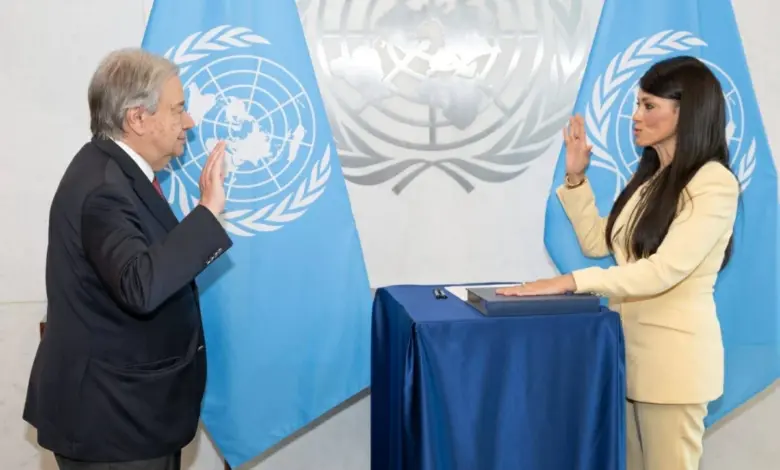
Rania Al-Mashat has officially taken the oath of office before United Nations Secretary-General António Guterres, assuming her duties as Under-Secretary-General of the United Nations and Executive Secretary of the United Nations Economic and Social Commission for Western Asia (ESCWA).
Following the swearing-in ceremony, Al-Mashat expressed her gratitude to the UN Secretary-General and the member states of the UN organization for their profound trust and for selecting her for this position.
She noted that this appointment comes at a pivotal juncture, during which the United Nations system is undergoing widespread reforms and structural transformations to keep pace with current demands amid the political and economic challenges facing the international community.
Al-Mashat outlined her vision and action plan for the upcoming phase, through which she aims to strengthen ESCWA’s role in supporting the national policies and strategies of member states, while expanding regional cooperation and shared spaces among different nations.
She highlighted several priority areas for the coming period, including shaping a regional narrative built on mutual benefits and knowledge exchange among ESCWA’s 21 member states. She also emphasized expanding joint cooperation and integration based on the principle of mutual benefit and regional value-addition, particularly in light of mounting global uncertainty.
Furthermore, she stressed the importance of highlighting transboundary cooperation models, such as electricity interconnection projects and maritime shipping lanes, among others.
Emphasizing that ESCWA’s motto is “Shared Prosperity, Dignified Life,” she asserted that the priority moving forward will be to measure the impact of implemented policies and link them to tangible, on-the-ground results that directly benefit youth, women, and society as a whole across member states.
ESCWA is one of the United Nations’ five regional commissions. Al-Mashat will lead the commission’s efforts to support Arab states on their paths toward sustainable development, foster regional integration, and drive economic and digital transformation agendas to address current global and regional challenges.